Please do not copy any photos without permission( click on photos to enlarge)

Wednesday, 27 July 2011

Weekend July 23rd and 24th

Tied up on other sites over the weekend so did not have a chance to visit Parliament, yet another pair has come to light, when I wonder will they reach there capacity in London?

It has been a good year for them, of the 9 sites that I monitor, many have produced fledged juveniles, in addition to this, Nathalies pair at Fulham&Barnes Peregrines successfully bred for the first time and fledged 3 juveniles.

As expected in Inner London, over 90% of prey is made up of Feral Pigeon, as you get out towards East London, many of the sites that I cover, you do begin to notice the difference in there appetites. I am now recording Ring Necked Parakeet regularly when I get the chance to visit nest sites once licensing restrictions are relaxed, this was recently the case at one particular site.


Juvenile Peregrines, not from the site above, even as Juveniles they are stunning looking Falcons

Unusual sight of a juvenile sitting in a tree

This site fledged 3 juveniles and whilst visiting the site for urgent works, the juveniles are flying now very strongly, I counted the remains of at least 7 Ring Necked Parakeets, this is mostly due to local abundance. The Peregrines are not having to go ‘looking’ for them, hunting takes place from the nest site structure as the Parakeets flyby. This site more than any other has the potential to turn up more varied species due to its geographical location, I am eagerly looking forward to collecting the prey at the end of August.


From this to the adult below, it sometimes takes a few months before they take there own prey

Adult with prey
I was also sent a photo the other day from the same site, this had been windblown over the side and was obviously quite an old kill, on examination of the photo received, It looks good for a Red Legged Partridge. As there is little suitable habitat in this pairs territory for this species, they are hemmed in by other Peregrines on all sides, it raises the possibility that this could well be another pair hunting at night.


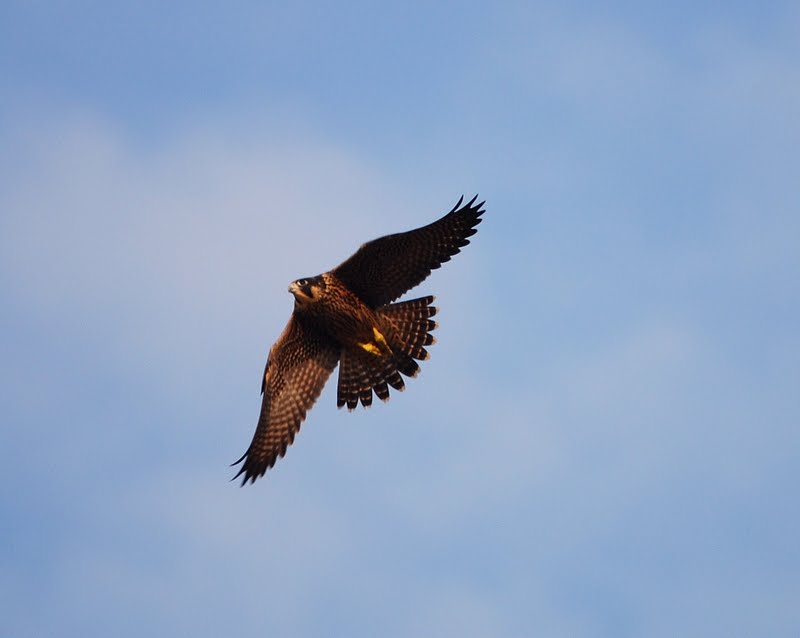
To see a Peregrine ' flat out ' at speed is a stunning sight,trying to keep the camera on it is another matter

I intend to visit Parliament this weekend in the hope that the whole family have now established themselves around the House of Commons.

We will see.

Sunday, 17 July 2011

Parliament - Friday and Saturday

Friday

As with the best laid plans, unfortunately the Peregrines again never read the script, perfect weather dawned on the Friday for filming but a bit of a no show from the peregrines.

The idea was to try and get some hunting footage, birds bringing in prey, food passes if possible from adults to juveniles, of the juveniles, there was only the female present, the 2 remaining males were back at the nest site.


Juvenile female, I suspect the one from Parliament, at an adjacent site being given the treatment by the resident Tiercel

Juve female over Victoria Tower (click on photos to enlarge)


Juvenile on Big Ben
Both adults were roosting on Victoria Tower at dawn, both flew up river immediately, no doubt to check up on and feed the 2 males.

The 2 males are sticking together and are seemingly tied to the natal site far more than there sister, this is despite having been over to Parliament on more than one occasion. Last year all stayed over and were more or less present on every visit.


Males tend to like there own space as they tend to get dominated by there sisters in the food stakes, even at an early age, this may well be one reason that they are not making the jump to parliament and are sticking together. There could well be other reasons, the nest site is there home, why move when they are secure there?


They can sometimes be very hard to spot, especially when there are stone Falcons up there already

Adult Tiercel

Spot the Peregrine

Adult


It could be with there sister at Parliament most of the time, they may realize that they are more likely to be first when it comes to prey where they are, without there sister present. Easy to read human emotions into it, the simple reason could be that they just like the nestsite area more.

During the course of the morning, around 4 hours from dawn, only the juvenile female was present after the adults left, and her presence was only every now and then.


Saturday

Just after dawn the 1st thing we heard was the calling of a juvenile from Victoria Tower, I was with Bertie Gregory, a young wildlife photographer who had arranged to photograph the birds from Parliament, again the 2 juvenile males stayed over at the natal site.

The 1st act of the adult Tiercel was to drive off an adult Lesser Black Backed Gull, as a rule, the adults usually ignore them at Parliament, with the juvenile present, different story.


Juvenile female

Same bird
Right from the start the weather started to turn foul, we did manage to get some shots of the juvenile and an adult but the light was very poor and not ideal.

Eventually the 2 male juveniles will come over, and I would expect them to stay, when, who knows? The only thing that may bring them over sooner is the adults, they are roosting on Victoria Tower, they may well hold to the Tower and hunt from it,the males will have to come over to be fed, hunger is a great motivator.

Thursday, 14 July 2011

Back! July 9th and 10th

At last it looks as if they are back although there hunting habits and behavior of juveniles seem to be in contrast at the moment from last years juveniles. On both days, after early starts, the juveniles followed the adults no doubt on hunting expeditions further afield, possibly bought on by a lack of localized prey. Like most pairings, the Tiercels in particular have favoured hunting areas, if prey does not pass by in the immediate core area, in short, go looking for it.


Juvenile dozing

Falcon - also dozing

Tiercel resting also
From what I did see of the juveniles on Saturday and Sunday, all were flying strongly before disappearing following an adult. On Sunday I waited for quite a while after seeing the whole family embark on a hunting expedition, the juveniles fighting and playing amongst each other whilst striving to keep up with an adult. On Saturday it was likely they had killed further afield and were possibly laying up after feeding elsewhere, juveniles along with adults, unusual, as more often than not, they will lay up on Victoria Tower.


Falcon on Big Ben


On Friday July 15th they are due to be filmed against the backdrop of Parliament, hopefully normal localized hunting will be the norm, the juveniles will put on a show like last year, and the weather will be good.


I took this at an adjacent Peregrine site, it shows a male Peregrine driving off a female juvenile, very likely the female from Parliament.
Good to see them back, quite a few people are already aware of them around Parliament, you might miss seeing them above, but you cant fail to hear them, great stuff!

Sunday, 3 July 2011

Saturday July 2nd - where art thou?

I arrived at Parliament at 4.15am, the weather was perfect for a change, with this I was hoping that they were present and I could take advantage and get some good photos. As with the best laid plans, they had not read the script, and despite a thorough search up to 4.40am, it was quite obvious they were still at the nest site.


What 4.30am looks like at Parliament (click on photos too enlarge)
I decided to head that way to confirm and also being Saturday, I was hoping that I could find a spot away out of the public view, especially as many were just turning out of the nightclubs. At this time of morning many of the revelers are the worst for wear, and although mostly harmless, you do have to be a bit careful when you are carrying a lot of gear around London.

I eventually found the perfect spot down a private road with no public access which was a dead end, it gave me good views of the site.


Juvenile Herring Gulls

Tiercel
I could hear the juveniles before I arrived, all food calling so it looked as if my timing looked good for some photography and to record some action. For my pains I had also ‘ set up ‘ just below a nesting Herring Gull, both adults gave me a hard time even though I was a good distance from there 2 curious juveniles.


Male juvenile with prey

Defending it from other male
It was apparent straight away that all the juveniles were flying strongly, eventually found the remaining 2 sitting on adjacent buildings. The adult Tiercel was hunting constantly, he killed twice, the Falcon once. Juveniles have sussed out that it is better to intercept the adult as it comes in with prey rather than wait and perhaps lose out to a brother or sister, hence some of the prey is being food passed.


Male with sister and brother trying to take prey


Peace after feeding
I suspect after watching them for a few hours that they will make the journey to Parliament pretty soon, there is now a few people waiting for them to arrive, including a film crew on Thursday, hopefully they will ‘ make the jump’.

Tuesday, 28 June 2011

Parliament Peregrines, they're back - briefly

June 25th

On Saturday I visited Parliament rather later than usual , around 6.30am, this was due to staking out another site at dawn which I knew held a territorial Tiercel. The weather at the other site was atrocious, heavy rain but good enough visibility to see that the male had got himself a mate, these days it is only a matter of time.

Yet another pairing, this one is outside London quite away, the structure they are on is far from ideal, but it is there core structure and the male has been there over 8 months, they will not move territory It will be impossible to keep this site unpublicized due to its location, and it also offers up a load of questions.

1. Allthough unsuitable, they will try and breed naturally obviously, probably next year, do you let them try and make a scrape on a surface ( flat concrete) knowing that the eggs may well roll. This could possibly happen year after year.

2. There are about 3 highish buildings around it, all unsuitable due to various reasons, do you risk letting them try and breed on one of these knowing that there will be licencing issues regarding roof space. This will only be if they cannot find anywhere to lay on the core structure. In this case, would it not be better to contain them to the core structure, however unsuitable.

3. Do you place a nestbox on the core structure that they are holding to, knowing that it is not ideal, especially for juveniles, but will give them a far greater chance of success. This site is going to be one of those, if successful, where the juveniles at fledging, will have to be monitored from dawn to dusk. The public will have to be involved.

4. Do you publicise a site knowing that it may put the birds at risk from a minority, the threat is minimal in London at the moment .On the other hand more eyes watching from the public can only benefit the birds.

Certainly food for thought, anyway back to Parliament.

As I arrived the first bird seen was a Tiercel, they or he was back! No sooner than he showed, he was quickly followed by the Falcon, I thought if they are both here, surely the juveniles.


Falcon - Middle Tower ( photos are poor due to typical crap english weather)


Both adults flew a few circuits around Victoria Tower and then landed. As they did I heard the unmistakable call of a juvenile, I quickly located him, it was the strong flying male, but despite getting raised hopes that the other 2 were here also, none materialized .


Juvenile male

Victoria Tower
At 6.55am both adults left together followed by the juvenile male, the heading was the nest site where, no doubt, the 2 remaing juveniles were waiting, so it proved when I viewed later.

I suspect that the adults have tried to lead them all over but only the juvenile male has followed. He was always stronger and fledged first, I suspect the other juveniles may not have the wing strength and confidence to make the 1 mile+ flight as yet.
                                                                                                                                                As I write this, who knows, it is only a matter of time, they could already be there, will visit at dawn on Saturday, fingers crossed for good weather and a family of Peregrines.

Sunday, 26 June 2011

Juveniles down


Each year I monitor a number of Peregrine sites at fledging time trying to gauge it right and be on hand when they ‘ jump ship’. Some sites you can work out more or less when they are likely to fledge, if you can get the exact date of egg laying (CCTV), and others I have to wait and ‘scope’ the juveniles to age them.

For those not familiar with fledging peregrines, they do have a habit of grounding as mentioned earlier in the diary with the juvenile that died in an unfortunate accident. Much depends on the nest area, if there is an adjacent flat area where they can exercise and make short flights, they are usually ok. The weather plays a big part, still windless days are a nightmare, no lift.

The nest sites that are confined are usually the ones that give problems, there simply is not enough room to build and strengthen wing muscles for 4, or even 5 juveniles.

Last year I was lucky, I had a couple low down, on separate sites, but these got back up under there own steam, hunger is a great motivator, if they are too low, the adults will not come down and feed them unfortunately.

Juvenile 1

On Thursday I was called to a site in London( Fulham&Barnes Peregrines ) , Nathalies site as a juvenile had come down, looking at it when I arrived, it still had 3 or 4 days to go to attain full fledging status, why it had gone we did not know, perhaps an adult had tried to coax it out with prey, or a strong gust of wind. (Looking at the CCTV recording later showed it went of its own accord).


Not very happy (all photos courtesy of Nathalie ) click to enlarge

Checking for injury


Peregrine juveniles like most birds of prey are full of attitude, this one certainly was as it did it best to penetrate my gloves, even as juveniles the strength they display in there talons is considerable, this was a female. A cardboard box had been placed over it to contain it, this also helps to calm it down. The juvenile was taken back up under licence, and then released on a high point near the nest site. The following day the adults found it and all was well.

Juvenile 2

This bird was in a confined nest area which did not allow much room for exercise, it was a small space even for the 2 juveniles that occupied it.


Friday was not an ideal day for fledging, little wind with no lift
This bird came down on the Friday, the site owners quickly contacted me and did very well in keeping the bird in sight, well done to them, I was then able to catch the bird and return it to a high point below the nest. It is good to know that the system works, it gives me a lot of satisfaction knowing that I and others have made a difference, these juveniles will now get the chance they deserve. The site in question is not manned during the weekend and is quite desolate, with the juvenile down and food/stress calling for an adult, there was every chance it would have ended up as Fox food.

Juvenile 3

This bird came from the same nest site as the 1st juvenile, it also fledged on the Thursday, it was seen to go on CCTV on Saturday and that was it, gone.

On Saturday late afternoon it was relocated, quite a way down from where it should be, and also not having fed.

On catching it, it was still lively so it was then taken back up to the roof to join its sister, we were hoping that the adults would feed it in the evening.
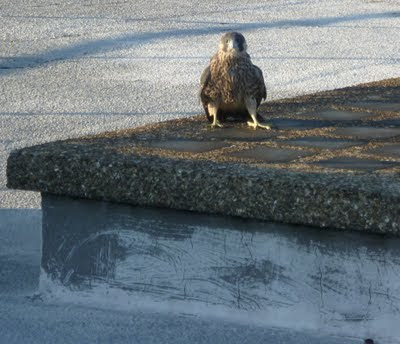

Little male

Taking it out on the glove, he eventually released it.
I learnt this morning (Sunday) that it seems to be making up for the last few days and has had 2 feeds along with its sister.

All the juveniles are now getting fed so they should be ok, juveniles 1 and 3 are from Nathalies site, there is a 3rd juvenile in that nest that has not fledged, fingers crossed…..

Monday, 20 June 2011

Falcons,both large and small

On my travels around London trying to keep up with the Peregrine population I get the chance to visit some unique sites, Factories, high rise blocks, derelict Brownfield sites along with working industrial sites. All are different and offer every kind of habitat going, disturbance on many is high, but on a number of these I have found that Peregrine Falcons and Kestrels do co exist and breed.


Male Peregrine

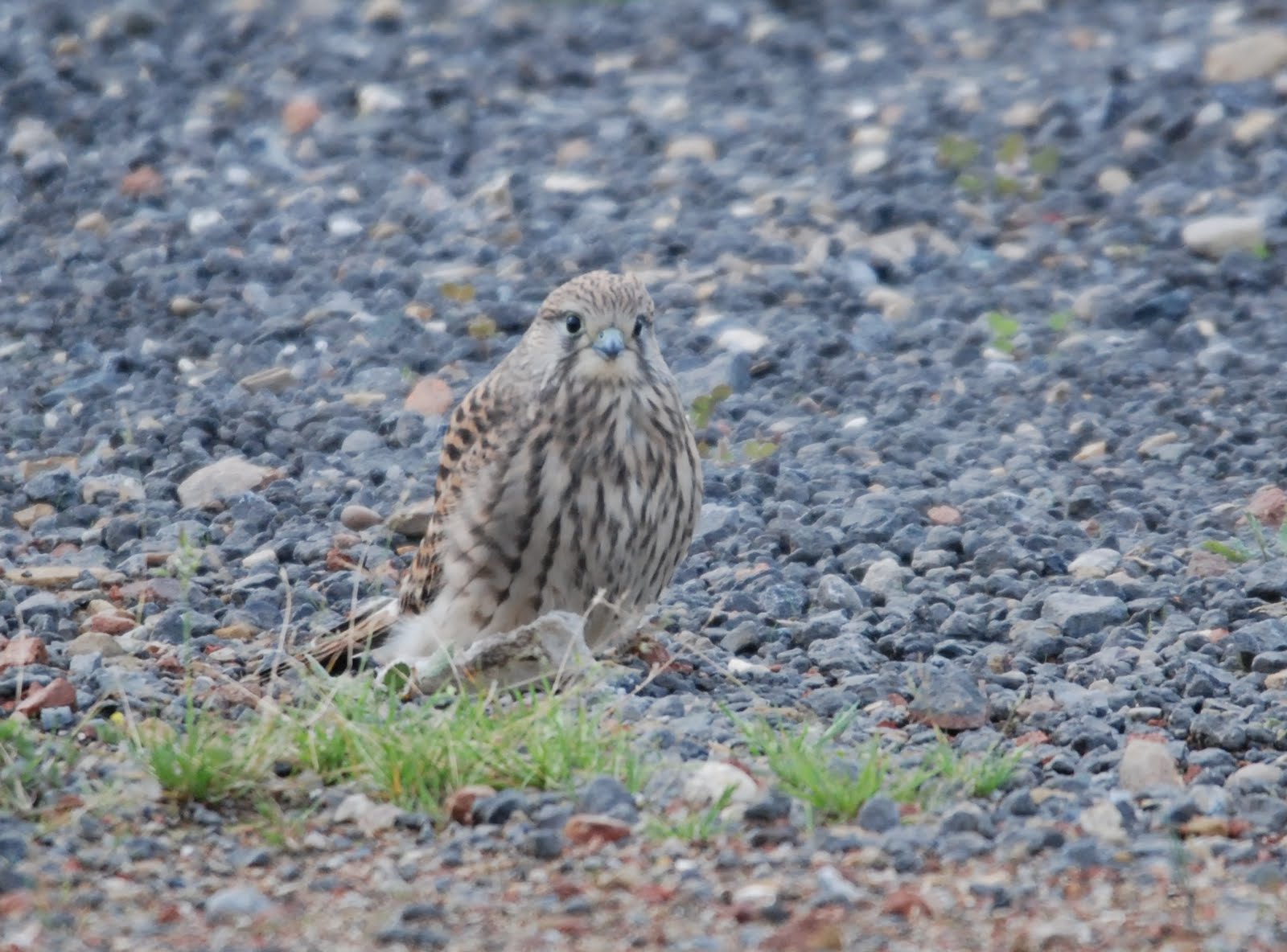
Male Kestrel
This year on the Peregrine sites that I monitor 4 pairs of Kestrel have bred on the same structure but at a lower level, both species are obviously aware of each other and there is some interaction between the 2 occasionally. It seems due to the abundance of prey in London, Kestrels are only occasionally targeted by Peregrines, the larger Falcon is basically lazy like most birds of prey, and seemingly always goes for the more abundant species.

In many cases this may be down to taste, feral pigeon may be more to there liking rather than Black Headed Gull for instance, the Gull is no doubt easier to take, so it could possibly be taste. Also the feral pigeon is just the right size to carry, I know that some Tiercels fly over a mile to a favoured hunting area, carrying the larger Gull back this far is hard work for the male, especially at dawn when there is no lift. I have recorded Kestrel as prey along with 2 male Sparrowhawks and know of other Kestrels taken as prey elsewhere. The smaller Kestrel will certainly go up and mob the Peregrine, I have seen this, some of this comes down to knowing when you can get away with it, and when not.

On all of these sites where the 2 coincide I have noticed that the Kestrels give the Peregrines a wide berth at dawn onwards when they are 100% hunting, they fly extremely low to and from the nest site, and will not go up high. When the Peregrines have killed, fed and then layed up, the Kestrels will go up higher and even thermal. The Peregrines, although extremely aggressive and territorial do not perceive them as a threat to eggs/young unlike Carrion Crows, these are attacked with relish, laying up or not.


Kestrel

Kestrel in flight
The Kestrels may just see the Peregrines as an occupational hazard, similar to Carrion Crows, they have a territory and a nest site, they are certainly not going to move site due to the presence of a higher authority, no matter how dangerous it could be.


Hopefully the Peregrines will stay with there normal prey

It is good to see the 2 species together, on one site both species have 3 juveniles apiece, that gives the possibility of 10 Falcons in the air, should be quite a sight.