Monday, 16 December 2013
Ringing return and a case of cannibalism
Juvenile 1
I was recently contacted by Jacob O'Neil who is a professional Falconer and trainee ringer who, whilst undertaking a visit to Watford came across not 1 but 2 juvenile/immature peregrines.
Furthermore he also managed to get some photos of both birds and after observing behaviour thinks they may be in the early stages of bonding looking like Tiercel and Falcon going on size difference.
Thanks go to him for contacting me.
It is unusual that at this early age they appear to have come together, I know that they are not from the same brood as one is showing a green ring and is likely one of the brood from London that John Black from NaturalEngland and I ringed on May 20th.
With Jacob’s photo I can see a green ring with white numerals; I know Sussex use green but if I remember correctly they use black numerals?
Hopefully this is correct, if so it is a London bird and came from a brood of 4, 2 males and 2 females, the trick now is sexing it and identifying which male or female it is, it’s hard to tell from the photo but it has the look of a female. Jacob had similar thoughts as well after seeing the 2 birds together, if this is the case it should be either ‘AL or AJ’.
Hopefully id can be confirmed but it is a good story as I always wonder where they end up, or indeed if they survive there first winter, whatever happens this juvenile has made a good start.
Juvenile 2
This rather sadly concerns a juvenile from the same brood and is not such a good news story, although it is nature and as such you can’t label it as horrific, it is sad, prey is taken daily although cannibalism it seems is a rare event.
The following owes much these days to the density of peregrines in and around London, prime sites are contested and it seems that prime foraging areas with plentiful prey species are being contested as well.
I am referring to Rainham RSPB and concerns an adult Falcon taking and eating a male juvenile which was witnessed by 2 independent observers whom I know well.
Below is the account of David Smith who observed it through a telescope relatively closely.
Whilst birding at Rainham Marshes yesterday morning [9/12/13] at about
nine o'clock I noticed an adult female Peregrine sitting on top of one
of the pylons that they regularly use. When I picked it up in my scope I saw
that she was feeding on a bird most of it had already been eaten but one
leg and part of one wing were still left, on closer inspection I was surprised
to see that the leg looked very much like a Peregrines leg that had
a green ring on it I couldn't tell if it was left or right as I was watching
the leg came loose from the rest of the carcase and fell to the ground
after watching for ten minutes the bird flew off in a northerly direction
with the remains of its prey. I walked round to the base of the pylon [38]
to look for the fallen leg but the vegetation was quite thick and I couldn't
find anything.
Since then I have visited to search for the leg also to see which male juvenile it was, it was either ‘AD or AN’ but as Dave says the vegetation is horrendous and it must have gone through and is unlikely to be found. Added to this, Foxes, Mice and Rats and its probably gone unfortunately.
What is unusual is the direction she left and also the fact that she took the prey with her, I am presuming she was going to her ‘core’ site to stash the remains. If that’s the case she is not territorial on site but it could be that the Reserve is on the very fringe of her territory and overlaps with 2 other pairs who also regularly use it.
I can’t see the mother of the juvenile taking and eating her own young even if it was long gone, I know they do recognise their own young, even the following year having witnessed it with other pairs.Allthough not welcomed back with open arms they are loosely tolerated by some pairings.
In regard to the 2nd pair that also use the site, if it was the Falcon from there, she would have flown in a different direction to stash the prey, knowing the nest site locations helps a lot, she’s not going to stash it anywhere where Crows can get at it.
It all points to a new female which is using the site and coming in from another direction, she is now being seen pretty regular on site and as yet I don’t know if she has a mate. If you recollect the old pairing succumbed, the Tiercel was killed flying into a fence and a little while later the Falcon disappeared.
Whatever scenario fits it is an unusual occurrence that may have started off as the juvenile possibly flirted or tried to bond with her even if it is early days, it could be that she saw him off and somewhere along the line it became deadly and she saw him as prey.
As we know they don't take carrion so I would have to presume she indeed took the little chap herself.

Monday, 9 December 2013
December and still present
December 8th
I made a visit on Sunday morning arriving around 7.10am in the semi darkness, no peregrines were visible from my watch point and the question in my head was, is the juvenile still with us?
This was answered at 7.25am when a single peregrine came out from roost quickly followed by another and then a 3rd, it was the juvenile bringing up the rear (wing silhouette) and quite obviously the adult Falcon had returned.

She was quite distinctive due to her size and all 3 eventually flew west, at the time I thought there all hunting and I could be in for a long wait. The fact that all were together and no apparent hostility was shown by the Falcon in flight looked like the juvenile is still being tolerated; I must admit I thought it would be a different story with the Falcon. To reinforce this there was some brief frivolities between Falcon and juvenile and all 3 had roosted in the same area, acceptance by the Falcon on the juvenile’s presence?
 |
| Juvenile and Falcon |

I was on the point of leaving as time went by, I thought that if they take prey further afield they would likely stay there and feed but no, one of the peregrines came in, the juvenile quickly followed by the Falcon with prey. It would be interesting to see if she would release the prey to the juvenile. The fact that the juvenile did not have the prey pointed to her not releasing on the return flight unlike the Tiercel in recent visits.
This was the case, despite the juvenile’s attempts to heckle her off the prey she would not release and fed herself, this took 48 minutes, she then took the remains of the prey and flew with the juvenile in pursuit and both were lost to view.
 |
| Falcon on prey with juvenile sitting close by |
It is possible that he claimed the prey after she stashed it or she would not let him have it, it’s hard to say. Both adults it seems are tolerating him to the extent that all 3 roosted together but I do wonder how long this will last until he gets a hostile reception and aggression from the Falcon.
The wing is most likely impairing his hunting ability but he should be able to take easier prey other than pigeon, this as long as it continues, is the easiest way of getting fed, I suspect watching him fly that he can take the slower prey on his own and probably has done.
I have also identified him, he is ‘RK, when the 4 were ringed on May 20th he was the smallest of the brood.
As I write this I have had some good news and not so good news.
The first concerns a ringing return from a local juvenile which has turned up further afield in Watford, and the 2nd, from the same brood, a juvenile male has been killed and eaten unfortunately by an adult Falcon at Rainham RSPB.Sad news but this is nature.
Although obviously not a common occurrence I have heard of this before, will post on both shortly.
Wednesday, 27 November 2013
What price December?
On Monday I paid another visit to a regular site, this is the site of the juvenile with the damaged wing referred to in very recent posts, see Late Juvenile and Late Juvenile – impaired?
As yet I have still not been able to read its leg ring but am now pretty sure it is a male after getting better views of its structure and head and being able to compare its size directly with its Dad on Monday.
It’s easy to be wrong with them and as much as you think you know, there is always more you don’t know, it is good to be wrong as it gives you a kick up the arse.
As you can see from above it is still present and I am now wondering if it will go into December, from all the visits in November, 4 in number it is solely reliant on the adult Tiercel to provide food although visually it flies well. The key I think to it staying that the Falcon seemingly has not been present all November , she does do this most winters and leaved the Tiercel to hold territory and defend the nest site. The Tiercel shows no hostility to it and I observed them on Monday morning sitting not a metre from each other, if the Falcon was to return now it may well be a different reaction and story. Would she just accept the juvenile still being present, who knows, do they recognise that it may not be capable of taking its own prey, I very much doubt it?
 |
| Juvenile |

On the part of the Tiercel the same thing has happened twice that I have observed, again on Monday also, the juvenile is intercepting him in flight when he is returning with prey, this is normal, a food pass. The adult has little choice in releasing the prey as he is so low anyway, it is always early morning, no lift or heat, a feral pigeon is quite a heavy bird. What I am getting at is he intentionally letting go and feeding him or does he have little choice in the matter? In short is the juvenile mugging his Dad knowing that in flight this is his best way of getting food off him, otherwise if he lands it might be a different story and he may not relinquish the prey and mantle it.
Additionally is the adult Tiercel so conditioned to feeding and providing even at this late stage, he possibly cannot help himself, the presence of the juvenile and the constant begging call just acts as a stimulus? How long does the maternal instinct go on for?
 |
| Juvenile |
 |
| Adult Tiercel |
Saying all the above, if the adult wanted the prey for himself surely he would fly to a different area and location to hunt and feed?
I have also been thinking of the wing damage, juvenile males always seem to leave first and one possibility is that he has tangled with another peregrine; at least 3 primaries are missing.
P2, 3 and 4 seem present but it looks as if P5, 6 and 7 are gone, possibly 8 as well, he flies ok, even with prey but I suspect it must effect his manoeuvrability when chasing prey.
The only other scenario would be an injury whilst pursuing prey and possibly clipping an obstacle low down in the heat of the chase.
Unfortunately this will not rectify itself until he gets his first moult in 2014, the trick will be staying alive that long…..
I am hoping that the wing damage is not as restrictive as I think and the adult Tiercel is being extra tolerant and allowing him to stay, will the Falcon share his views when she returns, I very much doubt it.
Tuesday, 12 November 2013
Late Juvenile - impaired?
This bird which I first noted back in September easily stands out due to the fact that she has some missing primaries in her right wing, what surprises me is that she is still present in November. It looks as if the adults are not only tolerating her but feeding her still, it is a little unusual this late but after watching both adults ignore her begging calls last week I didn’t expect her to be present on Sunday, let alone being fed.
Even more of a surprise was the fact that the Tiercel allowed her to take prey off him after last week; this took place in an aerial food pass as the juvenile intercepted him. It could be that he didn’t have a lot of choice, he was low and had to release, it was very early in bad light and he was possibly struggling with the prey. With her hanging on there was likely no other option, additionally also it could be that to an extent, juvenile females, due to their size and brood dominance over males bring about this reaction even from their father. He in particular of this pair is the main provider and the instinct to react to the begging calls and feed is still strong, he is still very territorial likely due to the juvenile’s presence. Having said that last week he totally ignored the juvenile but the Falcon was present, following her lead?
I have heard from America that some brood juvenile females have dominated adult Tiercel’s returning whenever they like and relieving them of prey, I suspect this is when the adult Falcon is not present.
Such may have been this case as I did not see the adult Falcon all morning.
 |
| Black Headed Gull being brave whilst she is bringing in prey in poor light |
 |
| The damaged wing clearly seen |
 |
| Lo light photo showing the extent of the damage - impairing her hunting? |
 |
| About to feed |
Another reason and possibly the right one is that the damage to the right wing is impairing her ability to hunt and it could be that she is having trouble catching prey of her own; this would make sense also due to the lateness of her still being present. She may still be so reliant on the adults, it could be she has not the confidence to go out on her own, I wonder how long they will tolerate her, especially the Falcon.
Thursday, 7 November 2013
Finding a perfect nest site
As many of you may know Peregrines are listed as a Schedule 1 species, and as such are given the highest protection that the Wildlife laws allow. All breeding birds, there active nests and eggs are protected under the Wildlife and Countryside Act (WCA) 1981.This protection makes it an offence to kill, injure or take any wild bird or to take, damage or destroy the nest of any wild bird whilst that nest is in use or being built.
Add to this in relation to Schedule 1 birds and the following is applied, it is illegal to disturb pairs while they are nest building, or at a nest containing eggs or young or disturb dependant young.
As such and across London the Schedule 1 licensing laws for peregrines apply from February 1st until mid July minimum, of course sometimes there are ‘issues’.
Peregrines are not tolerant of people when nesting and in most cases when they are nesting on or slightly below a roof top the whole roof becomes off limits, even large roofs. In many cases even if the incubating Falcon is not in view it will be likely that the Tiercel will be sitting above or at the highest point of the nest site to cover any ‘threats’. Anyone walking onto a roof and visual, even at distance, he will react loudly and at times this is communicated to the incubating Falcon and she comes of the eggs/young, not good. Of course this constitutes disturbance.
Getting and finding the ideal building in London is becoming harder, many are renting out there roof space to the Mobile Phone Companies and this obviously generates money, from this you can see where the conflict arises if peregrines come along and decides to nest on the roof. If this happens as you can imagine it is not always well received when I have to tell companies there is now no access during the licence period unless a proven emergency, and only then with a licence holder present.
By and large though the mobile phone companies have been great on established sites and some companies recognising that it is likely to be long term have totally enclosed there walkways to their huts so as to offer no disturbance and more importantly avoid breaching the wildlife laws.
Other issues that arise are routine roof maintenance and window cleaning, beit an office block or residential block, the law again applies, people want clean windows, I do but if windows are cleaned via access from the roof the law again applies.
I can see both sides and you have to be able to see the bigger picture, obviously being licensed carries a certain level of responsibility and you have to be fair and not just lay down the law at every opportunity. You can’t just say – you can’t this and you can’t that, there has to be a compromise of sorts to keep everyone happy.
As the title says finding and keeping the perfect nest site is hard in both settled and new pairings, in the case of new pairings they choose the building and you just have to go with it. Peregrines are totally unpredictable and as I have said in the past the same reasoning cannot be applied to all, each pairing has its own characteristics.
Structures are less troublesome due to their lack (usually) of human habitance at higher levels – Churches, Cathedrals etc.., the downside to this sometimes is a lack of exercise space for fledging juveniles, in some cases it leads to grounding. Having said that much depends on the weather on the day of fledging.
I visited a site on Thursday morning in north east London which has failed for the last few years on a structure which is unsuitable it seems for breeding, this site is due for demolition so I and others are trying to find them an alternative site. Having scouted a number of buildings within their territory all are residential and all have mobile phone masts on the roof, placing a nest box would lead to conflict.
I have two other avenues to explore and it is unlikely that the first choice will be accepted, but the 2nd although not ideal in terms of position it has the height and if a nest box was to be allowed it would face in the right direction, east. The bottom line is it would give them a chance, its within there territory.
Time will tell, I know a well placed nest box is all that this pair need for successful breeding, finding a nest site is another matter.
Monday, 28 October 2013
Masters of the Wind
October 27th
On Sunday despite the very strong wind conditions I visited a site in London to check up on a pair; early morning rain soon gave way to some welcome sunshine. If you have watched peregrines before you will know they revel in these conditions, flying becomes effortless and at times they hold position against the wind with hardly a wing beat recalling Common Buzzard.
This particular pair fledged 2 juveniles this year, both of them, a male and female have been gone for well over a month, on Sunday the male tried to return and beg for food. Of course this could be another male juvenile from another site, hard to tell, but going on the adults reactions, there was a certain level of acceptance, I think it was there offspring. If it wasn’t I am pretty sure that they would have driven him off as soon as he came into their territory.
 |
| The juvenile |
All was ok until the juvenile tried to muscle in on the Tiercel, he had just taken a feral pigeon, the Falcon seeing this became very aggressive, I suspect as the Tiercel usually hands prey to her in most circumstances, she saw her meal being threatened. Additionally from her reaction afterwards, he was obviously not welcome anymore, in short time to go.
She then went after him and pursued him high and low, relentlessly chasing him and both were lost to view, she returned shortly later and I thought that was it. Remarkably, he is obviously a stubborn juvenile, he came back, the process was again repeated with even more gusto by the Falcon. He was seen off and despite me looking for him for the next hour he never returned, he had undoubtedly got the message, hopefully he will get through his 1st winter.
 |
| The juvenile trying to shake his mother, he couldn't |


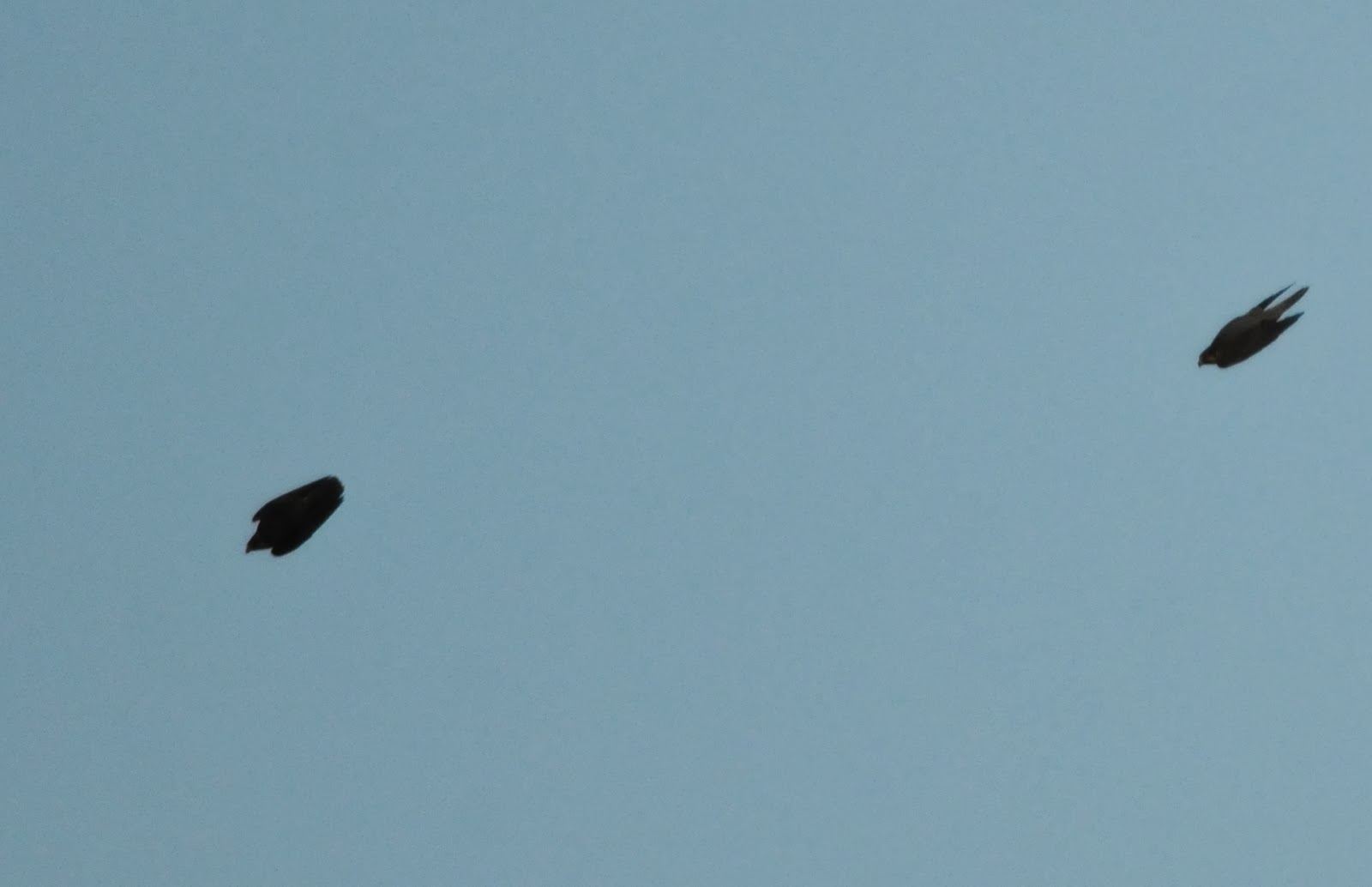
Sunday, 20 October 2013
Pellet Antics
I photographed this male peregrine the other day going through all the usual contortions trying to bring a pellet up.


Subscribe to:
Posts (Atom)