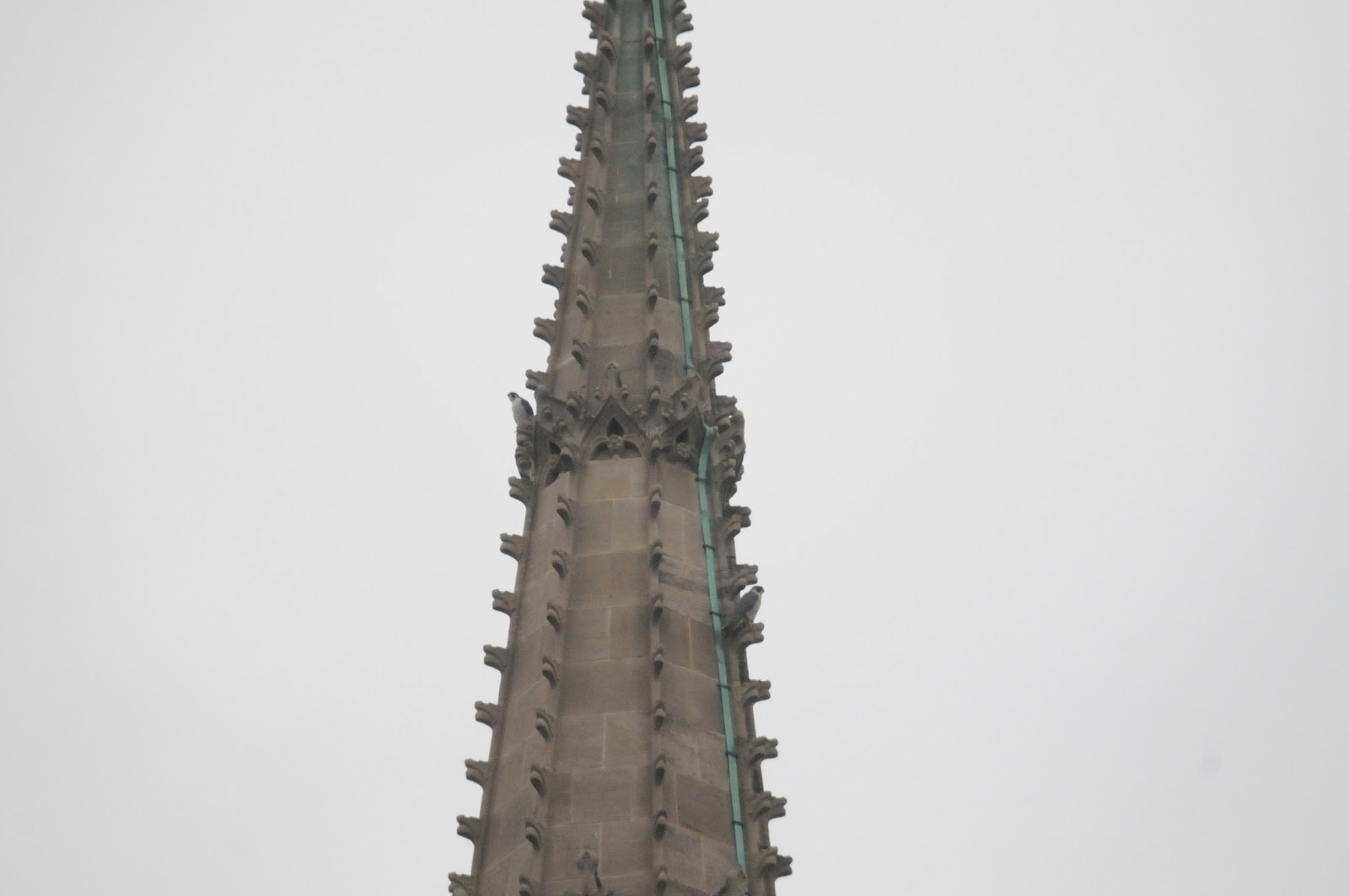
Due to the numbers of peregrines in London, it is inevitable that they will find structures and buildings that are not suitable, either to hold territory on and ultimately attempt to breed on.
2 years ago I located an adult Tiercel on a structure, which due to its location and position always meant that, for breeding purposes, it was not ideal.
Early last year an immature Falcon turned up and the Tiercel was a happy boy, as expected due to her immaturity they did not try and breed but summered.Pre Christmas 2011, she now had her adult plumage, she disappeared for a while, some Falcons do this if there is no external threat from other peregrine pairs, food shortage has never been an issue in London. Late January she showed up again, the markings showed her to be the same Falcon, consequently nature took over and breeding was in the air with the pair copulating often.
Around March 28th she disappeared from view, consequent watching showed a couple of nest reliefs on the structure, by now I had decided exactly where she had made her scrape, it could not be seen but she emerged from the same position on 3 occasions with the Tiercel taking over incubation.
On April 8th after a series of heavy downpours, both the Tiercel and Falcon were permanently on show, obviously they had failed, the likely reasons being chilled eggs, lack of drainage on the level of the scrape or eggs simply rolling.
It is not uncommon for 1st time breeders to fail, in fact it is the norm but it does bring forth thoughts as to how to make them succeed.
Firstly every other tallish building in the vicinity is not ideal, either due to rooftops being used for Mobile Phone masts, they have to have 24/7 access, a nestbox and the Schedule 1 laws would stop any access. Others are just too low, additionally neither bird has never, as far as I am aware, used any of the surrounding buildings.
Secondly they never even looked at any other building/structure as an alternative; it was always going be ‘the structure’ where they are resident.
Working on the assumption that they will now hold territory every year and attempt to breed on this structure, it is likely that they will fail more often than not, this is usually the case in an urban environment unless they are assisted- Tray or Nestbox.Bearing in mind that the structure is not ideal for fledged juveniles and they may well ground, do you encourage them to successfully breed by placing a nestbox aloft knowing that it may lead to problems for the juveniles?
In my mind it has to be yes, obviously with the owner’s consent, they deserve the chance. Our unstable April and early May weather puts paid to many pairs on pylons, sometimes due to the fact that they don’t always use a stick nest and may well just lay on bare metal or some accumulated dirt. Consequently eggs become chilled/roll very easily, in short it is the exposed position that puts paid to them, hence the need for a nestbox.Such is the case with this structure.
A nestbox will solve the problem of a number of issues relating to their failure but successful breeding will also provide the challenge of grounded juveniles. In this case due to its very high urban location (people) and the dangers of, basically being run over if they ground, the only way I see forward is to publicise the site.
This will make the public aware of them and signs will have to be put in position during the breeding season, they are already known locally, this is the only way to safeguard them, as well as this local people can then get involved in their future.
It appears from the stats on the previous post that Falconers have been having a look at the hybrid, if anyone could shed any light on its identity it would be welcome.I have stated that it is an escaped Falconers bird as it fits no description, especially colour, of any Falcon that I know, if you know different I would welcome a comment.
Monday, 16 April 2012

Sunday, 8 April 2012
Peregrines - out and about
April 3rd
With so many Peregrines in London now I am spending more and more time trying to keep tabs on them, the best time has always been dawn, this is when you will likely get the information that you require to either confirm breeding or simply going through the motions of summering/ non breeding.
Such was the case this morning, up at just before 5.00 and in position by 5.45a.m,many of London’s Tiercels have a habit of slipping away in darkness to favoured areas where feral pigeons leave a roost, if you miss this you arrive on site and there is nothing. A Tiercel can be away from site sometimes for hours, once they have killed the Falcon will come out and feed, the Tiercel will then incubate. Once she has fed and filled her crop, she may just lay up and rest/or go straight back on the eggs, usually to the annoyance of the Tiercel, many are reluctant to hand over as they like to incubate. He may well hunt again in the afternoon after feeding off the remains of what the Falcon has left or he may retrieve stashed prey.
As it turned out, I sat there for 2 hours, I know they are there but it is likely he went in complete darkness and I didn’t see him go, additional to this I know of at least 3 pairs in London that are hunting at night, mainly in the winter months. If this had happened at this site he would have been present, either incubating or profile perching on ‘guard ‘duty.
Moving on to another site where they successfully bred in 2011 I was surprised to find a hybrid present, I knew he was in the area but it now appears that he/she has either paired with the Falcon/Tiercel or the pair from last year have moved site.
It appears from others that this bird is disrupting breeding to 2 pairs it seems ,I know over the last 2 weeks there has been some dogfights with a 3rd bird involved, presumably it could well be the hybrid.
I first saw it about 4 years ago, presumably it is the same bird, I know it has been doing the rounds of London as I keep hearing reports of a grey morph Gyr/Peregrine type here and there. Escaped Falconers birds are becoming a pain in the arse around London, the worry is that they will get into the peregrine bloodline.Dont get me wrong, it is a stunning looking bird but it is not good news if it disrupting breeding due to its size of an established pair.From here I moved onto another site.
By the time I got there the Tiercel was resting up on a Luffer Crane; this overlooks the incubating Falcon and is the male’s favourite perch.
On arrival a very amusing sight greeted me, the crane was working and the Tiercel was still in position perched at the very top!
Such is his bond and territorial tie to the nest site and the crane, (he could easily move to another lofted location nearby but further away) he stayed in position.
For the duration of the visit, about 40 minutes, he travelled north, south, east and west, up and down, only occasionally lifting a wing or 2. The cable wheel at the top was about 500mm from him and constantly revolving, by his actions he was obviously used to this.

He was alert but it looked like he was not going to move for man or beast, the resilience of Peregrines never ceases to surprise me, I left there laughing as I saw him going on another circuit.
With so many Peregrines in London now I am spending more and more time trying to keep tabs on them, the best time has always been dawn, this is when you will likely get the information that you require to either confirm breeding or simply going through the motions of summering/ non breeding.
Such was the case this morning, up at just before 5.00 and in position by 5.45a.m,many of London’s Tiercels have a habit of slipping away in darkness to favoured areas where feral pigeons leave a roost, if you miss this you arrive on site and there is nothing. A Tiercel can be away from site sometimes for hours, once they have killed the Falcon will come out and feed, the Tiercel will then incubate. Once she has fed and filled her crop, she may just lay up and rest/or go straight back on the eggs, usually to the annoyance of the Tiercel, many are reluctant to hand over as they like to incubate. He may well hunt again in the afternoon after feeding off the remains of what the Falcon has left or he may retrieve stashed prey.
As it turned out, I sat there for 2 hours, I know they are there but it is likely he went in complete darkness and I didn’t see him go, additional to this I know of at least 3 pairs in London that are hunting at night, mainly in the winter months. If this had happened at this site he would have been present, either incubating or profile perching on ‘guard ‘duty.
Moving on to another site where they successfully bred in 2011 I was surprised to find a hybrid present, I knew he was in the area but it now appears that he/she has either paired with the Falcon/Tiercel or the pair from last year have moved site.
It appears from others that this bird is disrupting breeding to 2 pairs it seems ,I know over the last 2 weeks there has been some dogfights with a 3rd bird involved, presumably it could well be the hybrid.
I first saw it about 4 years ago, presumably it is the same bird, I know it has been doing the rounds of London as I keep hearing reports of a grey morph Gyr/Peregrine type here and there. Escaped Falconers birds are becoming a pain in the arse around London, the worry is that they will get into the peregrine bloodline.Dont get me wrong, it is a stunning looking bird but it is not good news if it disrupting breeding due to its size of an established pair.From here I moved onto another site.
 |
| Gyr/Peregrine hybrid? |
By the time I got there the Tiercel was resting up on a Luffer Crane; this overlooks the incubating Falcon and is the male’s favourite perch.
On arrival a very amusing sight greeted me, the crane was working and the Tiercel was still in position perched at the very top!
Such is his bond and territorial tie to the nest site and the crane, (he could easily move to another lofted location nearby but further away) he stayed in position.
For the duration of the visit, about 40 minutes, he travelled north, south, east and west, up and down, only occasionally lifting a wing or 2. The cable wheel at the top was about 500mm from him and constantly revolving, by his actions he was obviously used to this.
 |
| Tiercel - not moving for no one |

He was alert but it looked like he was not going to move for man or beast, the resilience of Peregrines never ceases to surprise me, I left there laughing as I saw him going on another circuit.
Saturday, 31 March 2012
Parliament Pair
March 27th
This morning’s visit was to confirm that they are at the alternative nest site, I knew they were from previous posts, I can also add that they are already incubating. A nest relief was seen briefly, Tiercel taking over from the Falcon with the latter returning after about 2 minutes when she found no prey stashed.Tiercels do like to incubate and he held on well as she screamed at him to come off the eggs, he grudgingly gave up his position and then flew north.
Throughout the course of the morning he really did not hunt in earnest, he even found time to copulate with the Falcon; it appeared that neither bird was in any hurry to feed, although the Falcons actions earlier belied this.
I did see rather an amusing sight, the Tiercel had departed, again north and the Falcon was incubating, into view came a Carrion Crow, he landed on the far corner of the nest site building, out of sight of the incubating Falcon but the Tiercel missed nothing. Just as I wondered how long he could stay there without the Tiercel seeing him, the Crow took off in a panic and made for some trees nearby. Into view, flat out came the Tiercel, the Crow went lower down towards the road, the Tiercel went with him, at one point he seemed to tap him, they do this quite often, eventually the Crow made the sanctuary of some lower trees.
It was quite a sight to see a Crow flying down the road at bus height with pyscho peregrine attached to his rear end, not one I will forget in a while and I have seen a few Peregrine/Crow disagreements.
Hopefully they will again succeed and fledge juveniles, a lot of people at Parliament are waiting for them to come back, hopefully it will again be early July.
On one pretty well known site in London that I monitor, the pair have not successfully bred since 2007 when they fledged 3 juveniles, before this they had been successful since 2001,blanking in 2004 and 2006.Since 2007 they go through all the motions, pair bonding, ledge display, nest site selection and copulation. Despite this and the obvious intent to breed no resulting eggs are forthcoming.
A few years ago I decided after comparing photos, that it was a new Falcon on site, the old one presumably having been usurped by this female, the problem I think lies in the fact that this Falcon may well be too old to breed, or simply infertile. I have even watched her through the telescope incubating on nothing, it was on a scrape she had made, I timed her and she was on the phantom eggs for 1 hour 40 minutes if I remember correctly, she did this on a number of occasions. I suspect it is the Falcon equivalent of a phantom pregnancy. It is something I have not heard of before regarding peregrines despite doing some research.
What surprises me is that the Tiercel has stayed loyal and has not ‘flirted’ with another passing Falcon and encouraged her in, for him to try and breed year after year with her the pair bond must be very strong. Alternatively, although old?, she may well be still strong enough to resist another Falcon. There is enough strength in depth in London nowadays that many sites are challenged daily, presumably by single birds, on one day alone on this site, I recorded 6 intruders, Falcons, Tiercels and immatures.
Alternatively I have always put it down to the Falcon, I know it is the 2nd Tiercel since 2001 but he was present in 2007 when they last succeeded, the fault I think lies with the Falcon, either age or fertility is an issue.
This morning’s visit was to confirm that they are at the alternative nest site, I knew they were from previous posts, I can also add that they are already incubating. A nest relief was seen briefly, Tiercel taking over from the Falcon with the latter returning after about 2 minutes when she found no prey stashed.Tiercels do like to incubate and he held on well as she screamed at him to come off the eggs, he grudgingly gave up his position and then flew north.
Throughout the course of the morning he really did not hunt in earnest, he even found time to copulate with the Falcon; it appeared that neither bird was in any hurry to feed, although the Falcons actions earlier belied this.
 |
| Falcon |
 |
| Tiercel |
I did see rather an amusing sight, the Tiercel had departed, again north and the Falcon was incubating, into view came a Carrion Crow, he landed on the far corner of the nest site building, out of sight of the incubating Falcon but the Tiercel missed nothing. Just as I wondered how long he could stay there without the Tiercel seeing him, the Crow took off in a panic and made for some trees nearby. Into view, flat out came the Tiercel, the Crow went lower down towards the road, the Tiercel went with him, at one point he seemed to tap him, they do this quite often, eventually the Crow made the sanctuary of some lower trees.
It was quite a sight to see a Crow flying down the road at bus height with pyscho peregrine attached to his rear end, not one I will forget in a while and I have seen a few Peregrine/Crow disagreements.
Hopefully they will again succeed and fledge juveniles, a lot of people at Parliament are waiting for them to come back, hopefully it will again be early July.
On one pretty well known site in London that I monitor, the pair have not successfully bred since 2007 when they fledged 3 juveniles, before this they had been successful since 2001,blanking in 2004 and 2006.Since 2007 they go through all the motions, pair bonding, ledge display, nest site selection and copulation. Despite this and the obvious intent to breed no resulting eggs are forthcoming.
A few years ago I decided after comparing photos, that it was a new Falcon on site, the old one presumably having been usurped by this female, the problem I think lies in the fact that this Falcon may well be too old to breed, or simply infertile. I have even watched her through the telescope incubating on nothing, it was on a scrape she had made, I timed her and she was on the phantom eggs for 1 hour 40 minutes if I remember correctly, she did this on a number of occasions. I suspect it is the Falcon equivalent of a phantom pregnancy. It is something I have not heard of before regarding peregrines despite doing some research.
 |
| Falcon from the site |
 |
| Tiercel |
What surprises me is that the Tiercel has stayed loyal and has not ‘flirted’ with another passing Falcon and encouraged her in, for him to try and breed year after year with her the pair bond must be very strong. Alternatively, although old?, she may well be still strong enough to resist another Falcon. There is enough strength in depth in London nowadays that many sites are challenged daily, presumably by single birds, on one day alone on this site, I recorded 6 intruders, Falcons, Tiercels and immatures.
Alternatively I have always put it down to the Falcon, I know it is the 2nd Tiercel since 2001 but he was present in 2007 when they last succeeded, the fault I think lies with the Falcon, either age or fertility is an issue.
Thursday, 22 March 2012
Weekend March 17th/18th
I started the weekend with a visit to Parliament, after February’s visit I have resigned myself to the fact that they will use last year’s nest site up river. It would have been good if they had stayed at Parliament but the lure of a successful nest site was always going to be a massive carrot. All being well they will return to Government around the start of July, again this is flexible and depends on how confident the juveniles are in there flying ability, it could be earlier, it could be later.
On arrival at Parliament I followed my usual routine covering all faces out of the wind in dawns light, I decided pretty early they were not present and headed off to the nest site.
The Falcon was seen briefly and the Tiercel was a statue on the top most section of the building, this confirmed what I had suspected, the main thing now is that they succeed.
There will be no camera this year unfortunately, this means there will be no dates of eggs/hatching/juveniles etc……. I will cover as much as possible from the outside. As mentioned before it is not an ideal area and there are a few unsavoury characters strolling around in the early hours, it pays to be a bit discreet when you have a Telescope, Bin’s and a Camera on show.
Elsewhere on the sites that I cover it is business as usual, the Tiercels are getting very aggressive towards the local Crows and all are in full breeding behaviour, including the pair at Fulham Palace Road.
After last year’s 3 downed juveniles it was decided and discussed to publicise the site with the backing of NaturalEngland, the pair are already known locally and the Hospital is as secure as you can get. Getting more local people involved will also mean added security – see Parliament Feb 28th.
There is now a web cam so that the pair can be viewed by the general public, a decent web cam is long overdue in London and I must say that the images and behaviour observed have been first class. Additionally the site is now being linked to Barnes Wetland Centre with Simon King broadcasting live as part of the London Wild Bird Watch 2012.
Website for Peregrine cam
http://www.wildlifewhisperer.tv/live-cams/1326
The pair caught everyone out by laying there 1st egg on March 14th, more or less 2 weeks early, as of yesterday (Wednesday 21st) they had laid 4 eggs.
On arrival at Parliament I followed my usual routine covering all faces out of the wind in dawns light, I decided pretty early they were not present and headed off to the nest site.
The Falcon was seen briefly and the Tiercel was a statue on the top most section of the building, this confirmed what I had suspected, the main thing now is that they succeed.
There will be no camera this year unfortunately, this means there will be no dates of eggs/hatching/juveniles etc……. I will cover as much as possible from the outside. As mentioned before it is not an ideal area and there are a few unsavoury characters strolling around in the early hours, it pays to be a bit discreet when you have a Telescope, Bin’s and a Camera on show.
Elsewhere on the sites that I cover it is business as usual, the Tiercels are getting very aggressive towards the local Crows and all are in full breeding behaviour, including the pair at Fulham Palace Road.
 |
| Female Kestrel seen on my travels |
After last year’s 3 downed juveniles it was decided and discussed to publicise the site with the backing of NaturalEngland, the pair are already known locally and the Hospital is as secure as you can get. Getting more local people involved will also mean added security – see Parliament Feb 28th.
There is now a web cam so that the pair can be viewed by the general public, a decent web cam is long overdue in London and I must say that the images and behaviour observed have been first class. Additionally the site is now being linked to Barnes Wetland Centre with Simon King broadcasting live as part of the London Wild Bird Watch 2012.
Website for Peregrine cam
http://www.wildlifewhisperer.tv/live-cams/1326
The pair caught everyone out by laying there 1st egg on March 14th, more or less 2 weeks early, as of yesterday (Wednesday 21st) they had laid 4 eggs.
 |
| Falcon at another site, going by Charring X, already incubating? |
 |
| The same Falcon |
 |
| Another Falcon, 1st egg is usualy around the 28th. |
Sunday, 4 March 2012
Parliament February 28th
I headed up to town on the tube as it was a weekday otherwise you have to pay petrol, Congestion Charge and Parking, before you know it your £30.00 out of pocket, London is an expensive place to visit in the week if you drive.£7.00 on the Oyster was not too bad as I arrived at dawn, around 6.45am, I left the telescope at home, too much gear otherwise.
Looking at the wind showed the union jack going westwards so I thought they would likely be on the east side. For the next 30 minutes I searched every nook and cranny, no peregrines, I gave the Middle Tower and Big Ben the once over, not a sign. By now I had decided they had gone over to last year’s nest site where they successfully fledged 3 juveniles, hopefully where ever they breed they will be successful again. I will keep an eye on Parliament but will now start covering the upriver nest site more.
During the course of the morning I kept a look out and had more or less given up on them when low and behold they came in, just as I was getting ready to go. Both landed on Middle Tower where I managed to get a couple of photos, despite this it still looks as if the upriver nest site is favourite.
Time will tell.


Another issue that I have been thinking of a lot lately is the number of pairs in London and there security.
Sad to say that in this country raptor persecution still persists and it is one big reason why sites in London are not publicised, it is a pity as the London public should have a chance to watch and be involved with these birds on their doorstep. It is an age old and awkward position, do you not publicise every site or publicise them with the view that, more eyes watching makes for a securer site. Parliament is publicised as it is secure, the Tate Modern is publicised as it is not a breeding site, in the end I think you have to judge each breeding site on its own merits and location, but is that right? If you get all the local people involved in each respective site there will undoubtedly be more security for the birds and that is what it is all about.
Out of town across the country other urban peregrine sites are publicised and on the internet, no problem. America, in particular New York, publicises every nest site and the world and his dog are involved, would the same approach be better in London, get local people involved?
If a minority of Eggers or Pigeon Fanciers want to find them they will, a recent court case showed this, an egg collector named 9 sites in London straight off the top of his head. In a rural location they should be kept unpublicised, there is little security on a lonely moor or cliff face to a determined individual. I have always kept all the sites that I monitor apart from Parliament unpublicised, but I must admit to re thinking, is it the right approach to each pair when it comes to their security and safety?

Looking at the wind showed the union jack going westwards so I thought they would likely be on the east side. For the next 30 minutes I searched every nook and cranny, no peregrines, I gave the Middle Tower and Big Ben the once over, not a sign. By now I had decided they had gone over to last year’s nest site where they successfully fledged 3 juveniles, hopefully where ever they breed they will be successful again. I will keep an eye on Parliament but will now start covering the upriver nest site more.
During the course of the morning I kept a look out and had more or less given up on them when low and behold they came in, just as I was getting ready to go. Both landed on Middle Tower where I managed to get a couple of photos, despite this it still looks as if the upriver nest site is favourite.
Time will tell.
 |
| Falcon |

 |
| The pair |

Another issue that I have been thinking of a lot lately is the number of pairs in London and there security.
Sad to say that in this country raptor persecution still persists and it is one big reason why sites in London are not publicised, it is a pity as the London public should have a chance to watch and be involved with these birds on their doorstep. It is an age old and awkward position, do you not publicise every site or publicise them with the view that, more eyes watching makes for a securer site. Parliament is publicised as it is secure, the Tate Modern is publicised as it is not a breeding site, in the end I think you have to judge each breeding site on its own merits and location, but is that right? If you get all the local people involved in each respective site there will undoubtedly be more security for the birds and that is what it is all about.
Out of town across the country other urban peregrine sites are publicised and on the internet, no problem. America, in particular New York, publicises every nest site and the world and his dog are involved, would the same approach be better in London, get local people involved?
If a minority of Eggers or Pigeon Fanciers want to find them they will, a recent court case showed this, an egg collector named 9 sites in London straight off the top of his head. In a rural location they should be kept unpublicised, there is little security on a lonely moor or cliff face to a determined individual. I have always kept all the sites that I monitor apart from Parliament unpublicised, but I must admit to re thinking, is it the right approach to each pair when it comes to their security and safety?

Sunday, 29 January 2012
Parliament January 28th
First visit of the year, I ended up rushing a bit even on a Saturday to make the dawn start, I made it in the end and located both birds roosting together on the Middle Tower at 7.30am, it was bloody cold, about 1 above but the sky was clear and promised a good day, this soon changed.
I was optimistic that I might get some hunting, especially after observing the Tiercels body actions, lots of head movement and position shifting. This proved correct when he launched himself north wards and left at speed, the light was still not good, I suspect he was trying to take a feral leaving roost. He returned about 3 minutes later, prey less but again adopted a similar position on Middle Tower. After 2 minutes he again left at speed, the same direction and I waited in the gathering light.
Even before I saw him returning I knew he had something just going by the Falcons reaction, she started to call repeatedly and her body actions took on an anxious stance as she ‘danced on the spot’.
He came into view with a feral and landed on Victoria Tower, she in the meantime had flown to the Tower and consequently took the prey straight off him, normal peregrine behaviour from the dominant female.
He adopted a nearby position to wait for the scraps, from his stance he had no intention of hunting again.
I watched them both until the Falcon finished feeding at 8.34am, instead of relinquishing what remained of the prey she stashed it, the Tiercel did not go and feed, perhaps he was not hungry as yet.
Both then flew a couple of circuits around the Palace before landing near to each other, from behaviour it appeared both were going to ‘lay-up’ and so it proved.
Later in the morning I checked the new nest box, they have not entered it as yet, there has been no disturbance to the substrate, and neither are there any new talon marks on the landing ledge. I am now pretty sure that the previous talon marks on the ledge were made by one of last years juveniles getting curious. Next month will give more information, as it stands on behaviour; I suspect they will go straight over to the other nest site. The main thing is that they breed successfully where ever it may be, if they go to the other nest site they will be back in early July.
For good measure and showing that the Tiercel was showing territorial behaviour to Parliament a Carrion Crow was attacked and driven off, who knows?
I was optimistic that I might get some hunting, especially after observing the Tiercels body actions, lots of head movement and position shifting. This proved correct when he launched himself north wards and left at speed, the light was still not good, I suspect he was trying to take a feral leaving roost. He returned about 3 minutes later, prey less but again adopted a similar position on Middle Tower. After 2 minutes he again left at speed, the same direction and I waited in the gathering light.
Even before I saw him returning I knew he had something just going by the Falcons reaction, she started to call repeatedly and her body actions took on an anxious stance as she ‘danced on the spot’.
He came into view with a feral and landed on Victoria Tower, she in the meantime had flown to the Tower and consequently took the prey straight off him, normal peregrine behaviour from the dominant female.
He adopted a nearby position to wait for the scraps, from his stance he had no intention of hunting again.
 |
| Tiercel waiting |
I watched them both until the Falcon finished feeding at 8.34am, instead of relinquishing what remained of the prey she stashed it, the Tiercel did not go and feed, perhaps he was not hungry as yet.
 |
| Falcon about to stash prey |
 |
| Tiercel |
 |
| Tiercel |
 |
| The pair at the stash site |
Both then flew a couple of circuits around the Palace before landing near to each other, from behaviour it appeared both were going to ‘lay-up’ and so it proved.
Later in the morning I checked the new nest box, they have not entered it as yet, there has been no disturbance to the substrate, and neither are there any new talon marks on the landing ledge. I am now pretty sure that the previous talon marks on the ledge were made by one of last years juveniles getting curious. Next month will give more information, as it stands on behaviour; I suspect they will go straight over to the other nest site. The main thing is that they breed successfully where ever it may be, if they go to the other nest site they will be back in early July.
 |
| Tiercel |
 |
| Nestbox |
 |
| The pair ' laying up' |
For good measure and showing that the Tiercel was showing territorial behaviour to Parliament a Carrion Crow was attacked and driven off, who knows?
Saturday, 7 January 2012
Season Summary
Happy New Year to all
First of all, apologies for the lack of postings of late, normal work and field bird surveys have kept me very busy over the last few months. I am a Steel fixer by trade, a family tradition and have been doing this since I was 16.Now at the ripe old age of 54, its beginning to tell on the body, everything is harder these days. In contrast the bird survey work is thoroughly enjoyable, how can you moan whilst getting paid for doing a lifelong hobby? I have grafted all my life Steel fixing, I am ready and hopefully soon, to concentrate on the birding alone, Peregrines of course as the priority.
Back to the Peregrines and the season summary, it has been a good year for the pairs that I monitor; new pairs have emerged again, on some of these I have to say a big thank you to the public for contacting me.
Of the pairs that I can publicise, Parliament were successful for a 2nd year, fledging 3 juveniles, one of which has already laid claim to another section of London, he has been recognised due to his orange leg ring.
For obvious reasons I can’t publicise the other locations, I wish we could, one day we may be able to do this; everyone should be able to enjoy these magnificent birds.
On one site I at last, after 4 years of trying managed to read the resident Tiercels leg ring, I have always known where he was from due to the colour, black, but have never been able to read the numbers. He was rung on the publicised site of Chichester Cathedral,West Sussex on June 1st 2002, he was one of a brood of 4, it shows how far they are going to find new territories in urban areas.It makes you think, do they just head for Cities/large Towns due to the fact that they were born in one, or do they just move on until they find an opposite sex peregrine or a building/structure where they are not challenged by other Peregrines?
Elsewhere new singles/pairs emerged, hopefully as mentioned above I can commit more time to each pairing, as it is, I simply cannot cover them all and give each pair the attention they deserve.
Urban Peregrines cannot be left to their own devices come fledging time, with juveniles jumping ship all round London roughly on the same period, you simply cannot cover every pair. More often than not, especially with the wrong weather on the day of fledging, they will and do ground. I understand about natural mortality, in the ‘ wild’ the mortality rate hovers around 30%.I do this along with others, to make a difference and give each juvenile I pick up and take back up the chance it deserves. The nature programmes where you see non-interference from camera men where juveniles are in trouble, I do admire them for being that way, me, I would rescue the lot.
It would be great and a far easier task for me if I could name the sites so the local public can be involved more in each respective site, all each one needs is a hard core group of peregrine enthusiasts to look after them. Due to a mindless minority of eggers/pigeon fanciers this is never going to happen, unfortunately this is the England that we live in, a small minority spoiling it for many, many others.
Fingers crossed for another good breeding season.
First of all, apologies for the lack of postings of late, normal work and field bird surveys have kept me very busy over the last few months. I am a Steel fixer by trade, a family tradition and have been doing this since I was 16.Now at the ripe old age of 54, its beginning to tell on the body, everything is harder these days. In contrast the bird survey work is thoroughly enjoyable, how can you moan whilst getting paid for doing a lifelong hobby? I have grafted all my life Steel fixing, I am ready and hopefully soon, to concentrate on the birding alone, Peregrines of course as the priority.
Back to the Peregrines and the season summary, it has been a good year for the pairs that I monitor; new pairs have emerged again, on some of these I have to say a big thank you to the public for contacting me.
Of the pairs that I can publicise, Parliament were successful for a 2nd year, fledging 3 juveniles, one of which has already laid claim to another section of London, he has been recognised due to his orange leg ring.
For obvious reasons I can’t publicise the other locations, I wish we could, one day we may be able to do this; everyone should be able to enjoy these magnificent birds.
On one site I at last, after 4 years of trying managed to read the resident Tiercels leg ring, I have always known where he was from due to the colour, black, but have never been able to read the numbers. He was rung on the publicised site of Chichester Cathedral,West Sussex on June 1st 2002, he was one of a brood of 4, it shows how far they are going to find new territories in urban areas.It makes you think, do they just head for Cities/large Towns due to the fact that they were born in one, or do they just move on until they find an opposite sex peregrine or a building/structure where they are not challenged by other Peregrines?
 |
| Falcon(click on photos to enlarge) |
Elsewhere new singles/pairs emerged, hopefully as mentioned above I can commit more time to each pairing, as it is, I simply cannot cover them all and give each pair the attention they deserve.
Urban Peregrines cannot be left to their own devices come fledging time, with juveniles jumping ship all round London roughly on the same period, you simply cannot cover every pair. More often than not, especially with the wrong weather on the day of fledging, they will and do ground. I understand about natural mortality, in the ‘ wild’ the mortality rate hovers around 30%.I do this along with others, to make a difference and give each juvenile I pick up and take back up the chance it deserves. The nature programmes where you see non-interference from camera men where juveniles are in trouble, I do admire them for being that way, me, I would rescue the lot.
 |
| Another grounded juvenile (Photo Nathalie Mathieu) |
It would be great and a far easier task for me if I could name the sites so the local public can be involved more in each respective site, all each one needs is a hard core group of peregrine enthusiasts to look after them. Due to a mindless minority of eggers/pigeon fanciers this is never going to happen, unfortunately this is the England that we live in, a small minority spoiling it for many, many others.
Fingers crossed for another good breeding season.
Subscribe to:
Posts (Atom)