Please do not copy any photos without permission( click on photos to enlarge)

Wednesday, 2 July 2014

The best of both World's?


On one site that I monitor there are 2 fledged juveniles which given the time of year is perfectly normal, a male and a female, fairly recently fledged, both were grounders, now ok and learning there trade from the adults. Unfortunately there was a 3rd juvenile but it quite simply disappeared and was last seen on June 4th, a Fox is the likely culprit.
There are a few people that watch them and recently, last week, I have had a few chaps coming up to me and saying that the 3rd juvenile has returned. At the time I thought they were likely mistaking an adult sparring with their off spring, hence 3 birds in the air.


June 25th - the resident  juvenile male and female


On Wednesday 25th I was watching the 2 juveniles, sparring as per usual when they disappeared from view and then re –appeared shortly later, only this time there were 3 juveniles!
I know the 3rd juvenile has gone, as above I last saw it on June 4th, I was nonplussed then to see a 3rd juvenile interacting with the 2 regular juveniles, all 3 were sparring and getting on, I knew it was not the missing juvenile.

Further still it was not being attacked by the adults, they were sitting watching the interaction between the 3, all was well.
On further investigation I looked and the new juvenile was carrying the standard BTO metal ring and also an orange ring, I knew then where it was from. It had come from another localized pair that breed around ¾ of a mile away, 2014 is the first time that both sites have bred successfully simultaneously. The juvenile, quite amusingly has probably come over seeking a meal, the best of both worlds, 2 sets of adults feeding you or so it seems.


June 25th - ringed female in middle

The male doing his thing

Orange ring can just about be seen on bottom bird - plumage is slightly different as well


I have read about it in rural pairs but this is the first time I have encountered it, additionally to this it looks like it is becoming regular as the juvenile was again present on June 27th, June 29th and July 2nd.

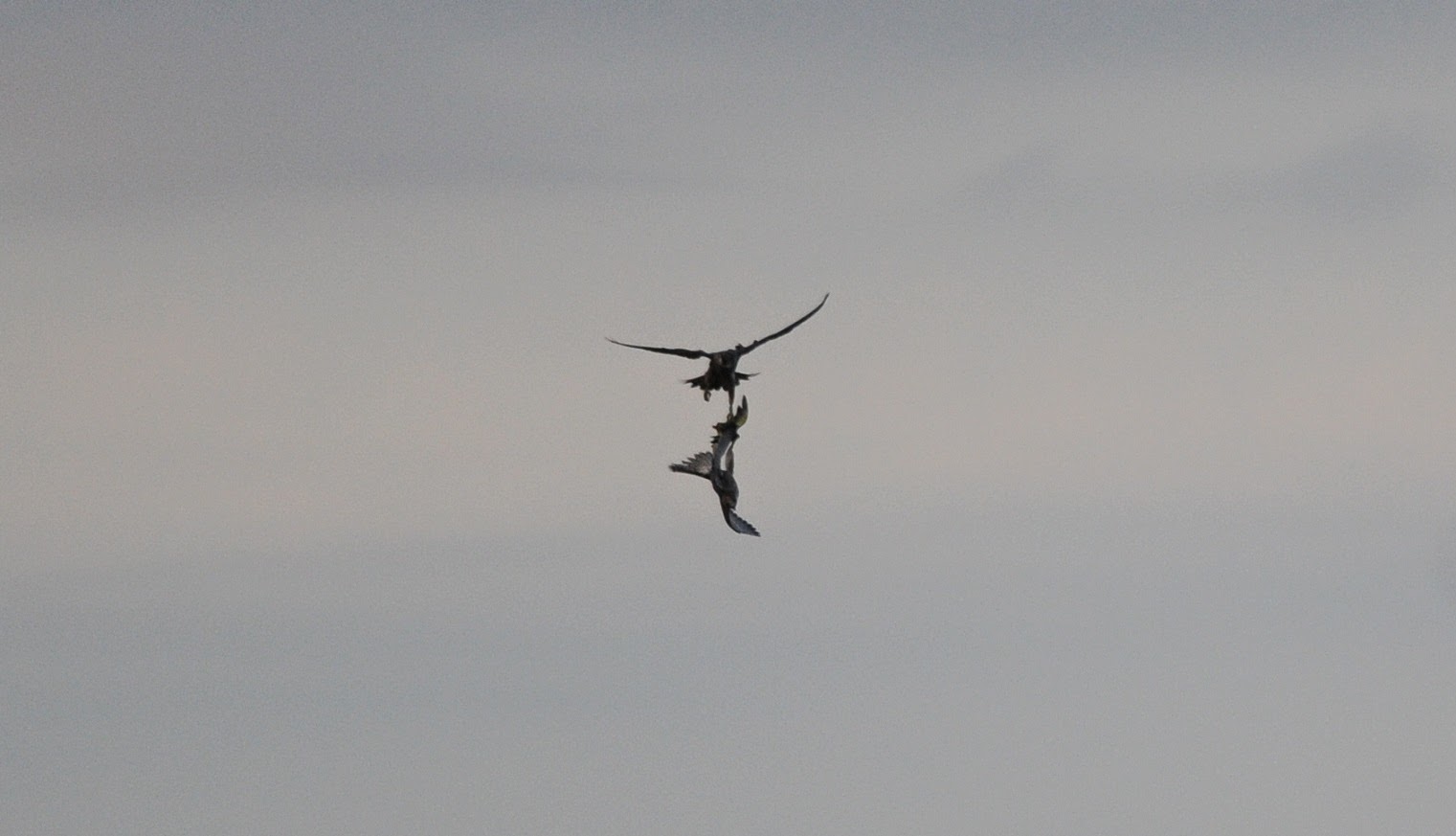
June 25th - there's a peregrine in there somewhere, can also see the orange ringed bird


I will keep an eye out for her, she is a female, but to all intents and purposes it looks like this pair have gained an extra juvenile, they are back up to 3.Furthermore the neighboring adults and 2 remaining juveniles have gone back to Parliament( they don't nest there), I looked on Sunday June 29th afterwards but only 2 juveniles were present at Parliament. It could be that our new juvenile missed the boat when they moved from their nest site to Parliament and has latched onto this adjacent pair, unable to find her adults and siblings. It could also be that she has been to Parliament and is using both pairs of adults? I find it hard to believe that she is not aware of them at Parliament. 

June 29th - presumably the same juvenile female - orange ring can be seen., adult was sitting near her.

Overhead pretty low - orange ring showing


Watching her this morning (July 2nd) the adults fed her, totally accepted as if their own sibling.

It may also be that the adopted adults may well see this new ringed juvenile as the original 3rd bird that was lost, even though that was 3 weeks previous.

It’s a first for me and very unusual and brings many questions to mind.

1. Is the ringed juvenile moving between her blood adults and adopted adults?
2. It is way too early for her to go it alone but has she been rejected by blood adults (highly unlikely)

3. Given that I know she has been present 4 times with her ‘adopted adults,’ she comes from a brood of 3, is it the same ringed juvenile I have seen on the 4 occasions? I have not been able to read the orange ring yet on her but if there is another female that was ringed on the neighbouring site, who is to say it is the same female on the 4 occasions?Unlikely I know.

4. After last year’s successful foster juvenile placed with another pair and perhaps given the very early stage of post fledging, the adults natural reaction is to feed and react to the food call, would they still give the same reaction, say at the end of July?

I will go to Parliament on Saturday to see if there are still just the 2 juveniles present, if not I know where the other one is.


Saturday, 28 June 2014

Prey


During the week I watched a site, the pair have had another successful year and have fledged 4 juveniles as per 2013.
During the course of the morning the adult Falcon was intercepted quite away out with prey, as you know with juveniles, it is first come, first serve for a food pass.

Below shows a sequence of photos showing 2 juvenile females squabbling over the prey, in this case a Ring Necked Parakeet, with the other 2 siblings waiting in the wings.


The 4 juveniles below after the food pass.

Adult Falcon above about to leave them to it

2 contesting the prey


Clamped on and trying to use her weight to take the prey


Held on successfully

Friday, 20 June 2014

Latest on Breeding


From the information I am gleaning from the rest of the country, it appears not to have been such a productive year in 2014, particularly in the historically persecuted areas up north and above.

Without doubt it is easier protecting them in London where you can secure buildings/structures and can ‘manage’ them easier, albeit less at fledging time.

Make no mistake urban peregrines due to the Schedule 1 have to be managed, it is all about forming a good relationship with the Building/Structure owners before and after the licence period of February 1st too around the end of June/mid July in London.
I am very lucky that in all the people I work/liaise with are good helpful people and safeguard the birds and will make sure they are not disturbed, I know at times it can be very difficult and not easy for them when they need roof access.

Thanks go to them all for without there co operation and good will, their respective pairs wouldn't achieve half the success attained over the years in successful breeding and fledging.

Adult female and juvenile male showing size and plumage difference


This year of the 10 pairs that I keep an eye on and monitor 9 pairs have been successful and have produced 25 juveniles, just under 3 a pair so a good return for all those concerned for their hard work.

Flooded Site


The success story this year along with Battersea Power Station has been the Flooded out site, this gave me a lot of pleasure, not so much at the time when the nest site was under 8 inches of water and the pair simply disappeared, I thought that was it.

As the site was on CCTV I was watching constantly as were others, the pair did return and glad to say that successful breeding took place and 3 juveniles, 2 females and a male fledged.

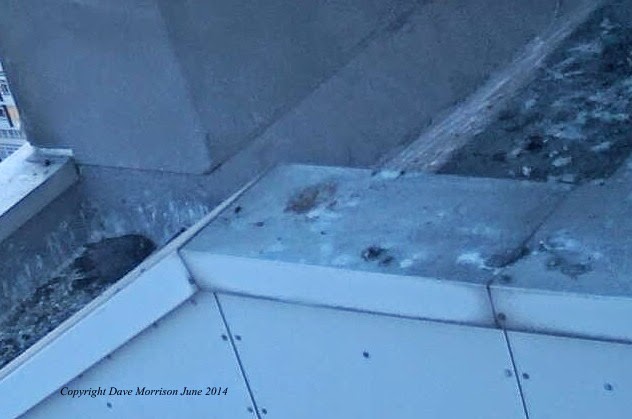
Completely flooded - Tray just visible with last years egg now turned white in the water

Cleared with old egg on Tray - the tray is now 9 years old, time for a new one

June 17th - all 3 fledged and flying strongly coming together pre -  roost


June 17th - all 3 at roost

As per usual with urban peregrines it was not straightforward and one grounded, a good system was in place with staff and I got her back up.


Scaffold Nest Box site


After last year’s success I was hoping more of the same but unfortunately not to be, this is the one failure of the year, no reason, she was incubating, perhaps a fertility issue?
I photographed her in Mid April sitting tight, obviously incubating and then made quite a few subsequent visits in early to mid May. She was incubating still right up to May 16th but kept getting up; I also noted her leaving the box unattended.

Realising that there were likely no chicks I kept monitoring before deciding to go up there to check for unhatched eggs, not surprisingly the nest box was empty.

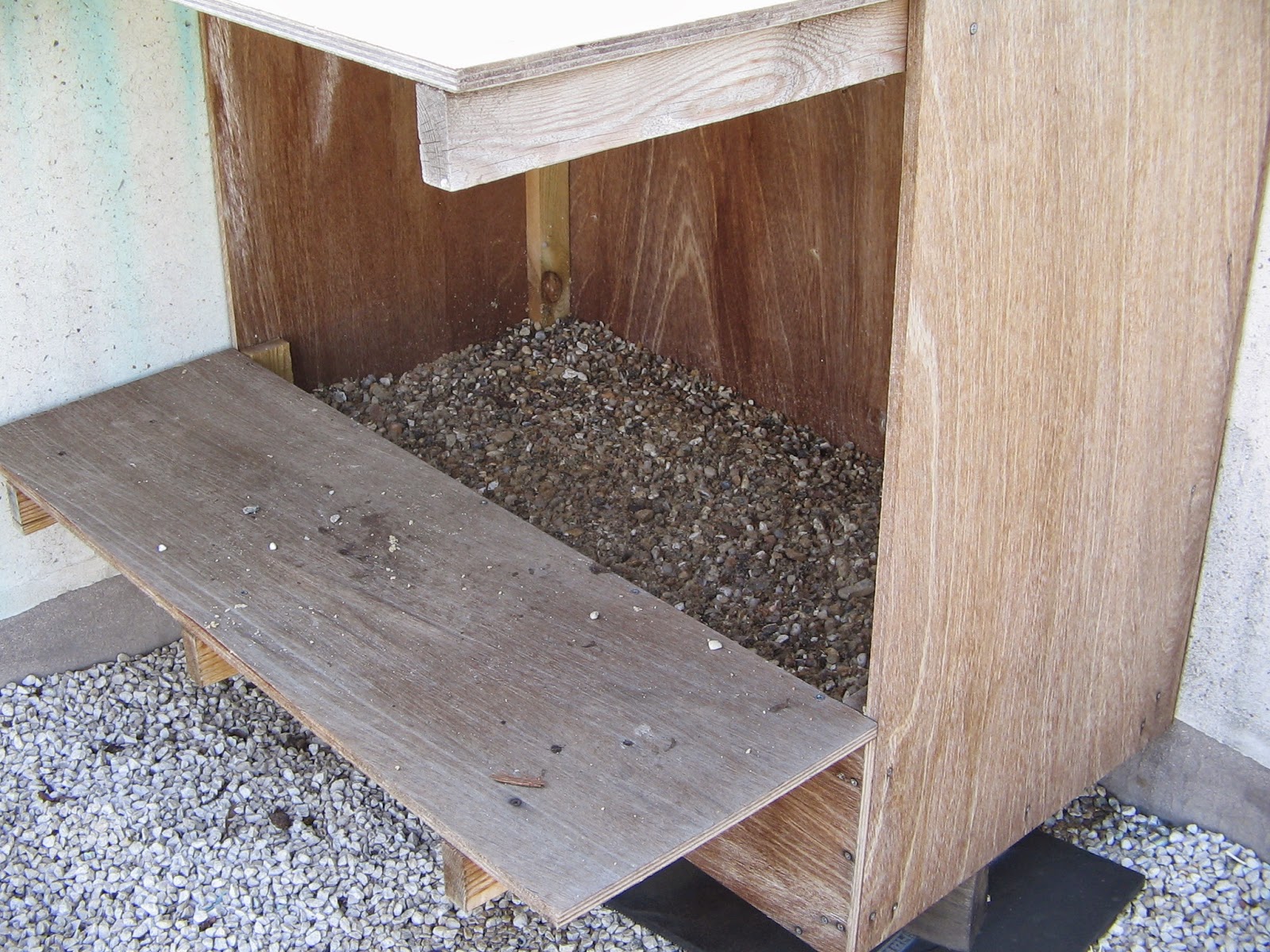
Scaffold Nest Box - empty

I suspect that she may have eaten them when they failed to hatch; it is easy to read more into it but this site is pretty impregnable.

There will be failures, this is a natural process, it may well be that one of them is getting a little long in the tooth, whichever bird it is I will keep an eye open for any change in adults.


Friday, 13 June 2014

Grounders


Its fair to say that the last few weeks have been manic, the now seemingly annual earlier fledging times have spread it out but it is hard covering a lot of sites.

The problem comes from the fact that the sites must remain undisclosed, a majority anyway, with increasing pairs how do you cover them all at fledging time?

It’s getting to the point with the numbers where I am questioning fledging time; do the undoubted risks in an urban site out way the non disclosure in publicising it?
There is no doubt that each site at breeding time needs a nucleus of local people involved to cover the grounding issue but how can people get involved if they don’t know there are breeding peregrines on their doorsteps?

To cover a site at fledging time you need a number of people involved, the more the merrier, each group can do a few hours each day and then another couple or group takes over. The site is then covered for a number of days, up to a week at times during staggered fledging usually beginning with the males.
If a few people or a group can get involved they will become passionate over them, (trust me I know), especially the chicks as they grow, you then have more people and eyes watching them, if a year round territorial pair on a structure/building, it need not just be the breeding season.

If you are going to publicise, some sites are more secure than others or to put it another way, more user friendly and a nice place to watch peregrines, I stress that I am only talking of the sites that I monitor. Some are not in ideal areas and walking round with expensive Optics and Cameras strapped to my body in the wee hours of dawn is like wearing a sign come and mug me on a couple of sites..
A lot of the night clubs turf out just as I am arriving so not ideal as you can imagine, 99% of people are good natured but there is always one or two who you keep an eye on.

With this in mind how can you ask the public/local people to get involved, let alone stand there covering a nest site building at 5.00am in the morning to cover fledging?

The grounding issue has arisen a few times in the last week or so and these are on sites that there is plenty of exercise space to build wing strength and confidence, alas hot still windless days as we know are not ideal. Of the 5 that come down, I lost one juvenile presumably to a Fox, it just disappeared, the rest were taken back up and given another chance. It’s no coincidence that the days that they fledged and came down were hot and windless.


Without eyes watching for them these likely would have been lost


Of the grounded birds, people were watching out for them, the system worked well but without these people there is doubt, given the dangers of an urban site, that they would have got back up under their own steam.

Perhaps if they had time, but the presence of Foxes, even Dogs, Cars on roads, Industry, the urban jungle and landing in areas which they can’t fly out from and being trapped means that the time is not always there.


Wednesday, 11 June 2014

Battersea Power Station


For 14 years now I have been coming to the Power Station since locating and confirming the 1st breeding Peregrines in Inner London in 2001, at the time I was a Steel Fixer and working next door.

I undertook and kept a diary and my old mate Des McKenzie very kindly spent a lot of time on it and made it readable and it was entered into the London Bird Report for the year - 2005.


The Power Station viewed from the north bank of the river.

The 1st breeding pair for London were recorded in 1998 by Adrian Dally, 2 juveniles were seen and both had fledged by the end of May, not unusual by today’s standards in London.
Adrian has written a report on it in the Essex Bird report, what was unusual for that time, was the fact that the whole family had left the Mill by the end of May, it seems likely that they had a ‘core’ site which they were unable to breed on. In this case very likely the O2 or the Dome as it was then. What was also unusual is that the adults, if not breeding at the preferred site of the adults (O2), would fly the juveniles back from the Mill to the O2 so early.

In the early days at Battersea, there was much to learn on them, there still is, there’s hardly a week that goes by that I don’t pick up some tit bit of information from the pair, by far most of my learning has come from the birds at Battersea.

Since 2001 I have documented them and studied them, as you can imagine the original Tiercel and Falcon have long gone and if I recall correctly to date, we are on our 3rd Falcon and 2nd Tiercel, a relatively high turnover but being such a prime Thames side site it was always going to attract intruders, to this day nothing has changed.


The latest pair about to hunt off the chimneys

Black Redstart doing his Peregrine impression on the dummy of the Power Station

Resident Tiercel

The Power Station as everyone is aware is an iconic building and I have been very fortunate and privileged to have access since 2000, in that time I have seen a number of changes and from a personnel point of view, it is good to at last see it being developed by Battersea Power Station Development Company Limited. The structure was falling into disrepair and although I enjoyed the solitude of my visits, it is high time the old girl was bought back to its former glory and renovated.

I must stress as I continue, there will now be regular updates, that all opinions and views are my own and in no way whatsoever do these opinions/views have any connection or represent the opinions/views of BPSDC.


Kestrels have also bred alongside the Peregrines

Egyptian Goose


This post will be the first of many, hopefully you will find it interesting, especially its wildlife, a unique site for London, it is a grand old building and a hard to miss reminder of a past era.

Monday, 19 May 2014

Nest Boxes Directions


These last few weeks have been very busy, I have had little time to post, rather foolishly I thought that when I retired from Construction and Steel fixing a year or 2 ago, I would have all the time in the world to do more things that are in my head, wrong!
I am in fact busier but I have to say it is a good busy – I am bird surveying regularly and am involved in Battersea Power Station and all its wildlife, it is a story that will be told shortly in what I have to say is such a unique site.

Over the years now, at my latest count, I have placed or made for a specific site around 14 Nest Boxes or Trays, in further correspondence and my continued monitoring, all but one have been accepted and used.
It’s nice to know you have made the difference but much of it comes from the fact that, although holding territory on an ideal building, many offer no nest site opportunity; in short they are desperate for a nest box or tray.

One thing that I have been asked a few times is direction of box, which way to face it, North, South, East or West. In some cases you have no option in direction as sometimes flight path and available areas dictate its position, it’s not always ideal but you have to go with it.

I mainly follow, as do others I expect, if its permissible face it East or East through to North if possible, having said that Peregrines being Peregrines don’t usually follow the script.


One such case happened in 2010, a nest box was placed and in this case there were options on all points of the compass, I decided on East, early morning sunshine for the incubating Falcon, position was good and offered access to an area for the all important wing flapping for juveniles, perfect.

Ideal, great early morning sunshine - even made a scrape in it, how could she refuse it?

What happened, she bloody well ignored it and laid in accumulated mud/guano opposite and facing in a westerly direction. She did fail, eggs rolled but I was surprised that she chose the west side with the constant wind but more importantly the wind chill factor for eggs/ chicks.

These days as you know, 90% of predominate winds are Westerly/South Westerly, as a rule I never face any in this direction unless the structure/situation dictates.
At the time I remember thinking she must be a young female, so I left the box where it was for the 2011 breeding season and monitored them regularly thinking it’s a one off.

By January 2011 she had made a scrape in the nest box and both adults, especially the Tiercel were in and out of it.

You know what I am going to say don’t you, come the end of March they went straight round to the western side and laid eggs in a deeper mud/guano scrape about a metre from the 2010 scrape. However this time the eggs didn’t roll, they hatched and 3 juveniles fledged.
Consequently in October of that year I moved the nest box round to the west facing side, about a metre from the successful scrape, they had the choice of either box or scrape.

It was never in doubt for 2012, straight into the nest box with all its westerly’s and south westerly’s in her face, they have now been in it every year and I will be checking in the morning to see how many we have.
2012 produced 2 juveniles and last year they fledged 4 so hopefully the same again.


The same box with scrape, now more weather beaten facing directly west.

It shows that although the form book goes with East through to North it doesn’t always work, the flight approaches on this building are clear all round, there is nothing to get in the way of their approach.
Sometimes there is no reason for them to ignore a nest box, I know of 4 that have been placed in London many years ago by Companies/Organizations, they have all been ignored although direction and position seem ideal.
However in this case, I think the main reason is that they are of the older design with the vertical lip and ledge, without doubt they prefer the walk in boxes where everything is on the same level.

I have made the older design in the past and they have been successful but I fazed them out a good few years ago now.


The older design - this particular one was successful but they much prefer walk in Boxes

Here’s to another good year.


Wednesday, 7 May 2014

New Cam - 4 Hatched !


Below is a selection of photos from New Cam, first hatch was on April 28th.I will post more info on these and other sites shortly, the last few weeks have been a bit manic.


April 28th - first view

April 29th - 2

Chick looking out

Feeding chicks

May 2nd - 4 !

May 2nd Feeding

May 6th - already growing fast

May 6th

May 6th - box accumulating feathers already

May 6th

May 8th Falcon brooding