Please do not copy any photos without permission( click on photos to enlarge)

Sunday, 27 January 2013

Parliament


January 26th 


With a forecast giving bright sunshine after rain I was optimistic that I could maybe get some photos, if they didn’t scarper.With the recent cold weather, snow and perpetual grey skies, the sun was more than welcome, you suddenly feel better and the world is a better place.
It obviously affected the pair as well, after a brief bout of hunting from Big Ben by the Falcon, both then retired to sunbathe on the Palace of Westminster.


Tiercel above - Falcon below

Arriving just after dawn courtesy of London’s roadwork’s and diversions, I made my way straight to Middle Tower, sure enough the Tiercel was tucked up on the eastern face, even better the Falcon was on top of Big Ben. Pair located, half the battle so I took a few shots, not in great light as yet it has to be said. 


Falcon on Big Ben or whatever they have called it now.


I watched in particular the Falcon, the spire on Big Ben is favoured as a hunting perch, I was hopeful of perhaps some pair hunting. After about 20 minutes with no movement 2 Jackdaws came through, I watched them as both were a relatively rare bird in Central London, when I looked back she had gone. Not only that he had gone as well, as mentioned in previous posts this happens to me a lot, you look away for a second and they slip away. 
They had not taken after the Jackdaws, not their normal prey, as I would have seen them so I up anchored and went searching for them.

By now the sun was up and clear blue skies were everywhere, I was optimistic; especially if both had gone that they could be with prey on the Abbey, this proved negative. Broadening the search I went into Victoria Park, bingo, both birds in close proximity on the east facing corner.
It soon became evident after 30 minutes that both, if they had been hunting had packed up and had decided to preen and sunbathe. It gave me an opportunity to take a few photos of them in situ, I then settled down to wait them out. The position they were in would hopefully give me some good shots as they flew, as they say the best laid plans…


Tiercel


Tiercel calling and getting ready to go

Falcon ditto...


After an hour when both had stopped preening and the Tiercel started to call and move around, I thought he is going to go and got the camera on him ready. As I did out of the corner of the other eye she went, tried to get on her, failed miserably, swung back to see him going away also, missed him as well. 
Cocked the shots up completely, I would like to say it was the Lens not being quick enough to focus but more like me not being quick enough.

After a short while both came back and settled on Middle Tower, I left them to it, a good morning and quite enjoyable just watching behaviour, like me they were enjoying the weather.


Pair after on Middle Tower

Wednesday, 16 January 2013

Where are they now?


Falco peregrinus 


The breeding season of 2012 gave us a good number of ringed juveniles, all wearing the standard BTO ring on their right leg with an orange band on their left leg denoting London born and bred.
If this colour was only used for London it would be easier, as it stands the colour orange is widely used all over the UK.
As there Latin names means “wandering or pilgrim Falcon” this implies that they travel, not only as a migrant but home grown juveniles will stretch their horizons as well. If this happens and a London juvenile carrying an orange ring enters another city where other juveniles have bred and carry orange rings also, it will give you some confusion unless you can read the numerals. Of course this will only happen after dispersal, say September/October onwards. To read the numerals you do need a telescope, notwithstanding that, juveniles usually allow a closer approach for binoculars until they get that wildness of an adult bird.

Thankfully plans and rings are now afoot this year for some London colour ringed juveniles to be given a London colour, dark green with white numerals, this hopefully will give us the info we need as long as ringing recoveries take place in the future.


When the juveniles disperse and make their own way in the world, will they make straight for an urban area as per there natal site? I have often wondered where they end up; ringing recoveries for London juveniles are very low, why? As a high profile bird that has a tendency to ‘profile’ perch on structures/buildings/pylons etc... we should be seeing more juveniles/immatures around the outskirts of London, ringed or unringed unless, as per above, are they are going straight out of town due to London’s density?
Mortality used to hover around the 30% mark but with milder winters and an abundant winter food source – surely the figure may well be lower now.


A Tiercel juvenile..where is he now?


The London Natural History Society Boundary, a 20 mile radius from St. Pauls Cathedral is well manned with abundant birdwatchers; juvenile/immature ringed or unringed peregrines should be on the radar more often and being seen more. I know of a few immatures around but nowhere near the juvenile/immature numbers that I know exist. 
As far as I am aware only 3 immature ringing recoveries have taken place over the last 2 years from London, there was also another bird located out in Essex last year if I remember correctly.
If they are not being seen, are they living up to their Latin name and wandering a lot further afield, or could some even go continental? There is no evidence of this; in truth I can’t see this happening.

Who knows, it could be that many immatures will hold to a coastal/rural food source/area as they are not strong enough to hold a territory of their own in the City or outskirts, this will mainly apply to the Tiercels.Once adult plumage is attained will they then try and move back to somewhere that resembles there natal site, or do they move sooner?
I know and have watched a number of sites in London that pretty regularly have their pairing tested, be it by an adult or immature, are these birds that are coming in from the outer counties or even further afield?

Myself and my colleagues at the LPP know where most of the London pairings are, the gaps between pairs don’t seem to be occupied by many singles or immatures, so to me that can only mean that most are going straight out of London.

New colour rings will give us good information…as long as they can be relocated.


Cleaning out nestboxes 

I recently saw the earliest copulation I have seen in peregrines, December 23rd no doubt brought on by the recent mild weather, needless to say its bloody cold at the moment.
On Monday I cleaned this pairs box out in preparation for the 2013 breeding season, and additionally I wanted to make sure the box was clean and hopefully parasite free if they laid early.

On arrival at the box I found that the Falcon had already made a good scrape so unless this cold weather puts the eggs on hold, there is the possibility that they may lay early. Boxes don’t get washed out naturally by the weather hence the annual substrate change.

Below shows the box before and after, firstly as it was with the scrape made by the Falcon, and then with fresh substrate and a new scrape made by myself. 


Pre cleaning with scrape, as peregrine boxes go this was pretty clean

Cleant out, new substrate and scrape


Wednesday, 9 January 2013

Parliament


Sunday January 6th


I visited on Sunday January 6th in the usual overcast grey murky skies, more so as it was foggy so I was not expecting great photos for the morning, after the last few visits I would be happy just to see and get good views of the peregrines at Parliament.


Even the top of the eye was in Fog

A 'flotilla' of Cormorants at dawn


Arriving at dawn I checked all over Victoria Tower to no end, they were not on it, so I checked the Abbey, again I drew a blank and returned to Parliament. The time now was 8.17am and I was beginning to think they are not here so I did another scan and found them, they were both on Middle Tower and tucked away so well in the murk I had overlooked them. 


The pair from the side before they flew

Middle Tower

Tiercel - blending in well


I decided I would get a better view from the bridge, they were round the side of the Tower so I walked round, Sod’s Law I got round there and they had both gone, this happens a lot to me, I move when I should just stand and wait. 
I returned and hung around the square and shortly later I got a brief view of the Falcon at 8.36am heading for Westminster Abbey‘s wide ledges with prey, I located her and then went into the Abbey Gardens to get a better view.
I found the Falcon feeding with the Tiercel patiently waiting nearby, the position both were in was ideal for photos, just a pity that the weather was so foul.
Prey was a feral pigeon and after a while the Tiercel started to make a bit of noise to hurry her up, no doubt he was hungry but such is the domination of the Falcon she was not going to share it until she had completely filled her crop.


Westminster Abbey 

Pair on 2nd ledge below


Tiercel waiting patiently

Trying to feed

Falcon laying up after feeding


I managed to take some video showing the Falcon finishing feeding and the Tiercel trying to get past her to the prey; it also shows how awkward they look when they run around on their talons, at times comical. As yet I have not sussed out how to post video on the blog but hope too soon. 

Whilst watching them I also attracted the attention of 2 American ladies, looking through the binoculars and telescope they really enjoyed the pair and watched for a good while, very nice people and good to spread the Gospel.

At 9.20am the Falcon let the Tiercel past and he settled down to feed, I then made my way to Victoria Gardens Park ,I was hoping that she would come over and lay up, better grey light so to speak, unfortunately she stayed on the Abbey and that was that.

She was still in this position when I left around 10.00am, a good visit and great to see them present.


Sunday, 30 December 2012

Dark Nights


December 30th
There are a couple of sites that I monitor that you can watch at all hours without drawing attention to yourself or to the birds, some sites are a little dodgy due to the area in daylight let alone at night in London.
The site I was at this morning are known nocturnal hunters, as I suspect most are in London, I have seen them on other occasions slipping away in darkness.
This site is illuminated by lighting enough so that I can pick out one or both birds on favoured roost spots through Bin’s, again this all depends on the wind direction, this morning was a strong south westerly so I went to the opposite side on arrival.

Arriving at around 5.30a.m I located one bird sitting where I thought he or she would be, in this case size wise it looked good for the Tiercel.When I have watched them before in darkness I have always tried to coincide the night visits with clear skies, the theory being that there would likely be more nocturnal movement by migrants.

Although my wife Christine thinks I am nuts going out in the dark (she has a point) I would really like to do a few all-nighters, the trouble would be staying awake. On this particular site which I watch a lot, I have arrived so many times at dawn and one or both birds are sitting there with full crops. Needless to say they are taking prey at night, I would like to know is this regular every night or just when the opportunity arises?

Nocturnally do they actively go looking for prey within their territory?
Do they just react and wait for flybys that are heard calling or seen visually?
Is nocturnal hunting only confined to urban sites and peregrines only?
If peregrines have the advantage at night, is more than one prey taken?
For the above this may well be true as a couple of years ago on this site, I found 3 freshly taken Redwings all stashed near each other whilst doing a prey collection the day after.

Lots of questions.

Getting back to watching them, nothing happened until 5.54a.m, when I looked for the Tiercel having taken my eyes of him, he was gone. At 6.02am he was back in the same position, he didn’t look like he was going to roost by tucking his head under his wing so I kept watching him.
At 6.08am he suddenly disappeared again, time went by until 6.14am when I got the briefest but positive view of a peregrine coming in to another part of the structure carrying largish prey.

The area he or she had landed on was known as a feeding area, unfortunately this was not illuminated enough and I could not locate any birds. I decided to wait for dawn.
I got the scope out when the light was good enough and had a scan of the area, the Falcon was sitting nearby with a full crop and the Tiercel was feeding on prey, as I watched every so often I got glimpses of a wing, tail or beak as he turned the prey. What I saw was enough to confirm a Woodcock; it was certainly not big enough for a Snipe.

The same Falcon seen later still showing a large crop

This now raises more questions, was it luck that I happened on this at this time of night or is there more nocturnal movement in the pre-dawn hours?

All interesting stuff, now that I am in semi-retirement, I will now have the time hopefully to find out.


Tuesday, 25 December 2012

Christmas Stuff


First of all, a very Happy Christmas to one and all.

I am now heading gracefully into semi-retirement, the obvious plus side to this is more time for London’s Peregrines, as it stands at the moment I have 3 nestboxes to place in January with a 4th box earmarked for the southern counties. Hopefully all will be accepted, peregrines never do the obvious and it is not always as straightforward as it looks, sometimes boxes are totally ignored seemingly for no reason whatsoever. More often than not though, if the box is placed near a known rest point on a core structure it is likely to be accepted.
This January as usual will be a fairly busy period with not only boxes and trays to place, but existing boxes cleaned out and fresh substrate replacing the old.

One of the very successful sites I am glad to say is Charring X, peregrines are messy and the video below shows not only the cleaning of the box but also the installation of the cameras. In HD the views of the pair and juveniles were stunning this year on the Wildlife Whisperer Web Site.

 http://www.wildlifewhisperer.tv/videos/shorts/1700


I visited one site last week where the pair due to their location have a large residence of Carrion Crows; as such the pair will not tolerate them, even on the fringes of their territory. Of all the pair’s that I watch this pair shows the most aggression towards them, much of this is due to the fact that many of the peregrines favoured rest/hunt pylons have crow nests on them.
In the presence of a peregrine, territorial pairs of Crows even at this time of year relax squabbling amongst each other and retain numbers to try and make life hard for peregrines.
I watched a confrontation last week where a pair of Crows have a nest on a pylon, even at this time of year the Crows feel the need to try and bait/ remove the peregrines from the pylon with others joining in to help.
Time after time a number of Crow circled the peregrines on the pylon, getting closer each time until the peregrines had had enough and drove them off.
This happened on a number of occasions and in the end there were 20 odd Crows sitting around at tree level waiting having given up.

Peregrine pair with Crows nest nearby

Falcon had enough

Crows going for ground

I also got the prey results last week for this particular site, these were very kindly forwarded by Ed Drewitt – see

http://eddrewitt.blogspot.co.uk/


Ed has been checking the prey for a number of years and without him much of the prey remains would not be known.
Some of the more interesting prey are listed below

Little Grebe
Coot
Ring Necked Parakeet - 2
Swift

The Coot I strongly suspect, as I know this pair hunts at night, was taken nocturnally as was the Little Grebe, this however is the first Coot I have recorded. Moorhen yes, they seem to be taken with some regularity at this and other sites, but Coots are a lot heavier and I suspect it was the Falcon who took it.Coots are a heavy bird, Peregrines are perfectly equipped to take larger prey nocturnally but they have got be able to carry it back to their core structure, or a resident high point that will give them the security to feed. I wonder if the Coot was possibly mistaken for a Moorhen at night?
Ring Necked Parakeets are now a firm favourite due to their sheer abundance in London.
The Swift also may also be a first as I cannot recollect another, although I know they are taken on other sites in London.

I am off to Parliament in the morning, weather permitting, hopefully some sunshine for a change,as I write this heavy rain and thunder so Boxing Day not looking too promising.


Sunday, 16 December 2012

A London Site


Last week I had the chance to visit a site in preparation for a new nest box; its position is one of the best I have come across in regards to suitability for Peregrines. Before a nest box or tray can be placed there are so many issues that have to be considered.

Is the building suitable for 1st flight juveniles?
Are there ledges lower down for juveniles?
Is roof access needed during the breeding season and the licencing period?
If a juvenile grounds, can access be arranged to take it back up or to a high enough nearby building so that the adults feel confident enough to come down and feed it?

There are many other considerations, security being paramount; I have to say that this building met all the criteria.
It was whilst we were up there that we came across first one, then another 2 Woodcocks making 3 in total, I would have to say that as Woodcock is a nocturnal migrant, all were likely taken at night.
One in particular was very fresh and I suspect caught the night before we visited, only partially eaten, nature is nature.

So little is known of nocturnal hunting peregrines but I would hazard a guess, basing much on prey recorded so far over the years that every urban pairing is hunting at night. It is an exploitable food source especially in winter with Redwing and Fieldfare going through in their thousands at night, who is to say it is only confined to urban pairings, why not rural pairings also?

A nestbox similar to the one that will be going to the new site

A peregrines view- hopefully they will like it.

This particular pairing failed this year, I know where she had incubated and it was easy to see why they had failed, the ledge was full of water, hopefully the box will give them the chance of breeding successfully.


Monday, 3 December 2012

Parliament


Sunday December 2nd


Glorious weather right from dawn, very cold with -1 showing but made easier given the sunshine that I knew was coming; I was hoping to get some half decent photos of the pair.
Unfortunately, similar to September 22nd and November 9th I did not even see a Peregrine other than a flyby by the Tiercel at 7.10am, he came from the west and flew straight over the river and that was that.

Knowing that they are very site faithful during the winter months you do look for reasons why they are not roosting on Victoria Tower as usual, is it the colder weather, have they a warmer roost building/structure? Peregrines are pretty tough, I have seen them out in heavy snow on structures that offer cover from the elements, in many cases they do not move even from heavy rainfull.They just fluff themselves up and sit it out.

Other than this you look for other reasons, have we had a change in the Falcon, this would explain the Tiercel not being present also and a new Falcon differing in her likes of different roost spots and favoured roost/rest ledges being ignored.
It really is conjecture until I can see both birds and compare photos; the simple reason is that they may at the moment prefer another building within their territory.

Another possibility being a very clear night with winter Thrushes moving over (I had a flock of 40 Redwing through), is that they have hunted at night and fed and are laying up on another structure. Who is to say that they do not find a structure near say, St .James Park at night knowing that night time migrants will be drawn into the ‘rural area’ and all the trees and bushes. When they have been absent before in late autumn/winter, does it coincide with clear skies and nocturnal movement?

So little is known of nocturnal hunting and peregrines, again it is all conjecture.

From Parliament I went on to visit a number of other sites, glad to say most were present, some photos below.


Falcon with a nice full crop


I also got a chance recently to visit one of my favourite winter haunts for raptors, the Isle of Sheppy, more specifically the raptor viewpoint down Harty Lane, photos below.

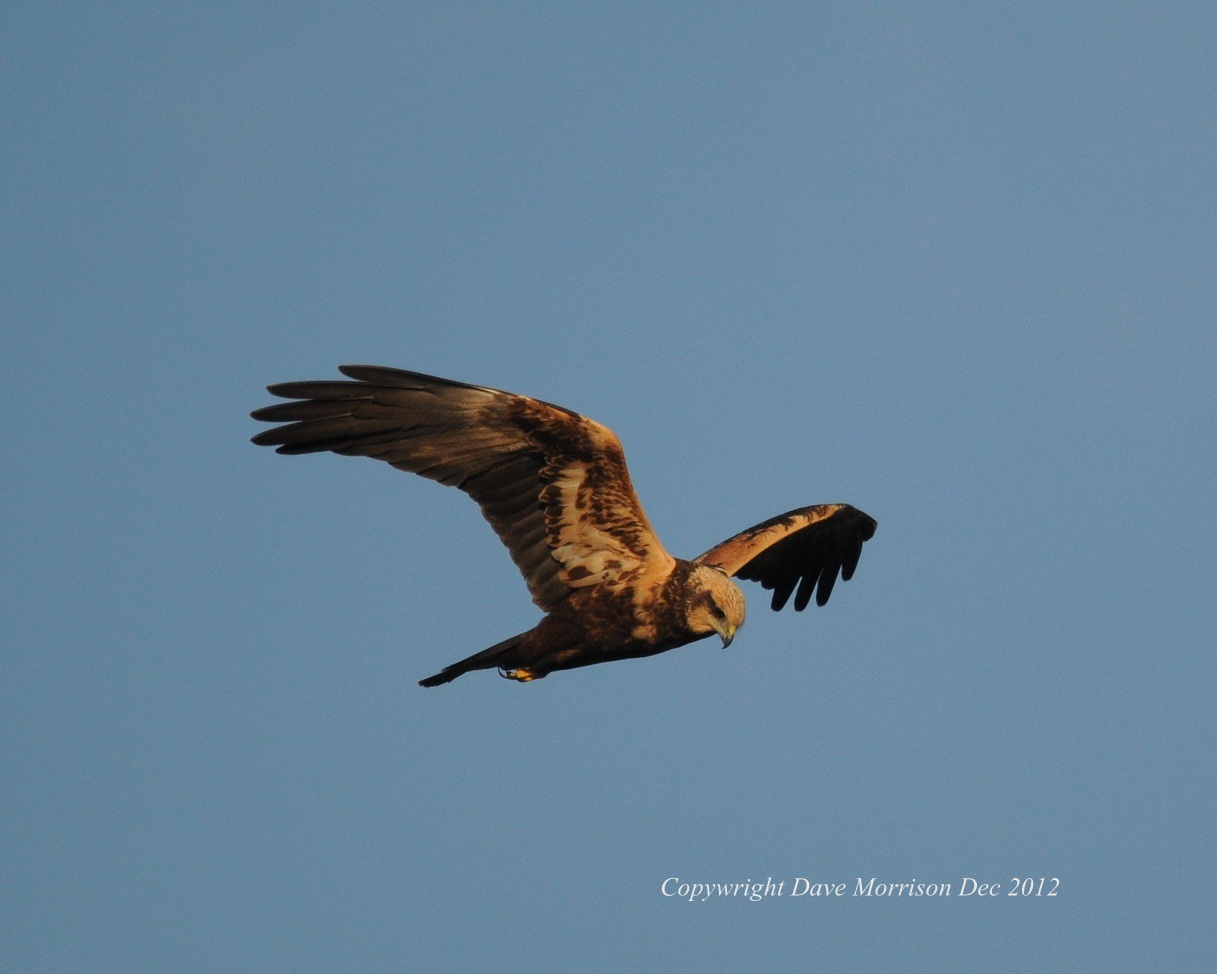
Marsh Harrier


A very pale Common Buzzard

I have been going there for 25 years, it very rarely disappoints and is a great place for some camera work.