Please do not copy any photos without permission( click on photos to enlarge)

Thursday, 14 June 2012

Last weekend - will they or won't they?


In the end 4 did and 4 didn’t, firstly another London site fledged that I monitor and then the Parliament birds, which laid at a slightly later date, stayed tight to the nest ledge and went through the motions with wing flapping and exercising.


Saturday June 9th

This London site I am particularly pleased with, last year only one fledged and he injured his leg – see ‘Injured Juvenile Peregrine’, this year there were 4 juveniles, this came to light after an earlier ringing and DNA session revealed the 4 little chaps. One of the juveniles was absolutely enormous and we were in no doubt she was a female, looking at the others going by size and weight it appeared we had 2 male and 2 females.
Arriving at dawn, not a good morning weather-wise, I have to say the weather is unbelievable at the moment, what summer? It soon became apparent that all were on the wing and were flying strongly enough to make me think that they had probably fledged a couple of days earlier.Allthough there flight was good enough, on this particular site grounding has never been an issue due to a massive roof to exercise on, there landings left a lot to be desired. Saturday was a windy morning and none were getting it right, in time they will, as they say practice makes perfect.


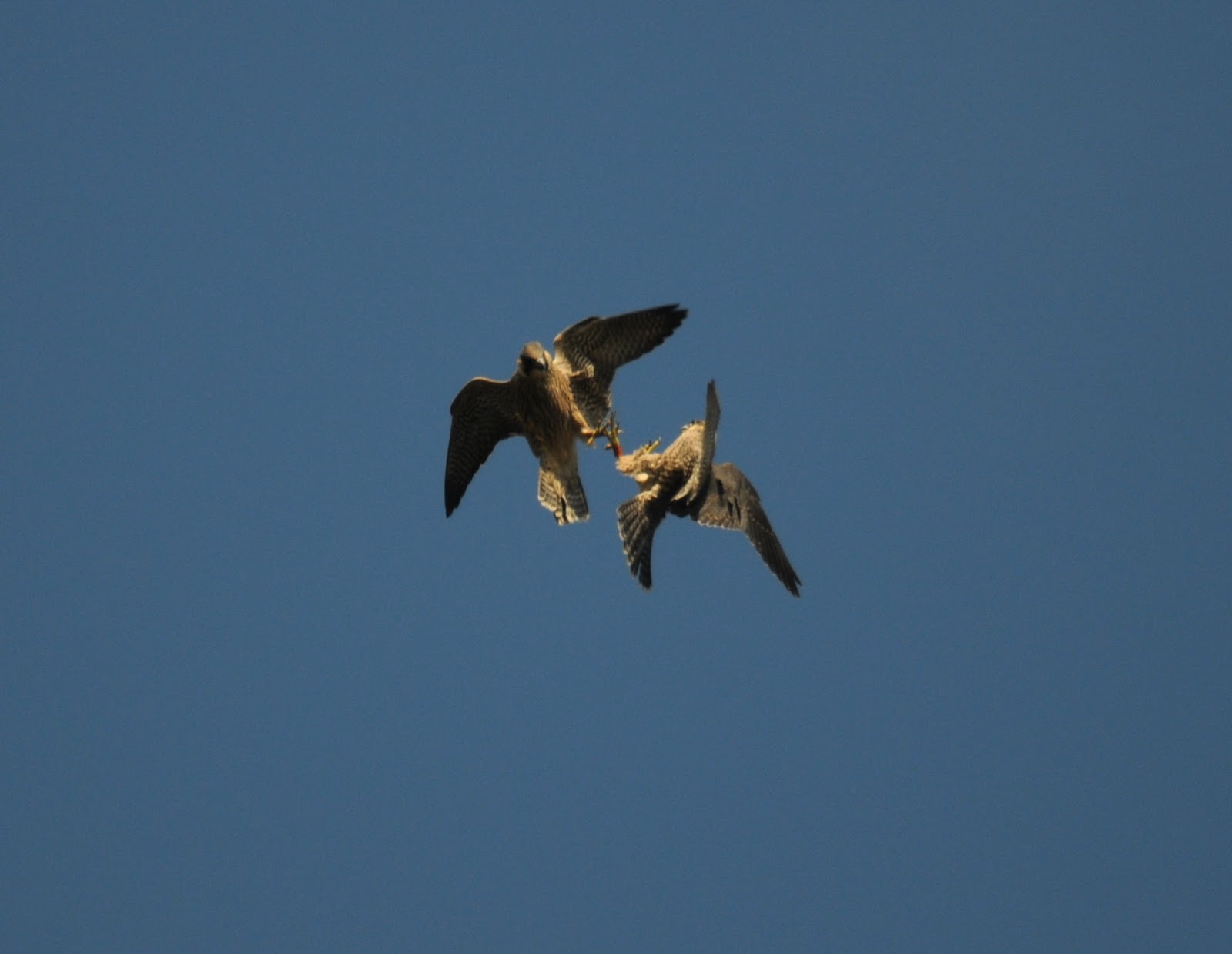
The same juveniles taken this week, sunshine at last!


Sunday June 10th Parliament birds

Arriving very early showed firstly 3 juveniles on the nest ledge and a little while later they were joined by the 4th.
I watched them over a 3 hour period and none showed any signs of taking the plunge, all seemed content but were wing flapping and exercising for the big day. The adult Tiercel was hunting constantly but never took prey while I was present. Looking at them I would expect them to fledge around mid-week, hopefully there will be no accidents.
Once fledged it remains to be seen when they will go to Parliament, the earliest date I have had is July 10th, they are eagerly awaited so it would be good to see them break the July record for arriving back.


Thursday, 7 June 2012

Ups and Downs


Having just returned from Bulgaria, as a birder it is a must, 16 species of bird of prey no less, it was again catch up time with the Peregrines in London.
As you can imagine it is hard trying to keep a diary going as you cannot name sites, especially if the diary participants (Parliament birds) move site every year. Due to their nest site location I am reluctant to take photos of the birds and draw attention to them; I have taken photos in the past but nothing that hopefully gives the game away. As mentioned before it is not an ideal area to be walking round with optics.
If they were at Parliament it would no doubt be easier, this may well happen in the future as the nest site building may well becoming under threat from Contractors.
This year they have 4 juveniles, hopefully all will make it and fledge without mishap, I expect them to start visiting Parliament around the 1st week in July, the adult Tiercel may well start visiting earlier to get away from the ‘ kids’.

Elsewhere on the pairs that I monitor, there have been successes and failures, the regular sites mostly coming up trumps but worryingly 2 pairs have gone off the map from their regular nest sites. These are the 2 pairs mentioned earlier in the blog, I have spent the last 2 month’s trying to locate both of these pairs to no avail, it is easy to read more into it with the persecution they face in other areas of the country. It could be simply a case of moving site but knowing the area and basically every suitable building within their territory it does make you wonder, why move from a successful nest site location? Both sites offer no disturbance issues so you do tend to think along more sinister lines unfortunately, this is the England we live in, raptor persecution is a threat, especially up north.
This weekend I am hoping to get to the Parliament birds to see how they are getting on, fledging is now very close, 2 of the 3 Charring X birds have taken the plunge, see below for the link.

http://www.wildlifewhisperer.tv/live-cams/1326

I have also dug up a photo taken last year of a hybrid that I think possibly may be the same bird that was seen recently in April holding to a Peregrine site. Looking at both photos I would say it is likely the same bird, the moustachial cheek markings seem the same as does the plumage and jizz of the bird.


This photo was taken in 2011


Saturday, 12 May 2012

Catching Up


Since returning from Spain last Sunday I have been out and about checking on the peregrine sites that I monitor. With all the recent bad weather it was likely that some would fail, sadly this proved true unfortunately. The exposed sites succumbed to the relentless rain and winds and goes to prove the case for a nestbox, it is no coincidence that the successful sites had boxes or trays or were covered by some part of a structure.
Having an insight into the webcam at Charring X both inside and out shows the extremities that Peregrines have to deal with, I know this is true of other species as well but very few will lay eggs in such exposed positions with little or no nest site drainage. The fact that they will just make a scrape in a ½ of dirt is always going to be perilous with egg chilling/rolling a constant threat in bad weather.
It also make you realise just how many nests, not only peregrines but other birds as well, which must have been lost to the weather.
Tragically Nottingham lost 3 of its 4 chicks this year, the weather played a big part again unfortunately; it was also not helped by the Tiercels disappearance for a day.

A flat out Tiercel, wings folded for maximum speed is an impressive sight


With prey, this time a Starling

So far this year of the ones that I keep an eye on, 2 have been lost to bad weather with 2 others moving site for one reason or another; plans are already afoot to give each of the failures a nestbox. Of the other 2 I simply cannot find them, both have moved from their traditional nest sites, and with a 2 mile or more radius for their territory they can be hard to find. Hopefully they will come to light.
I have not commented on the Parliament pair for a while, but after a visit this morning at their breeding site, I can confirm that they have chicks judging by the adult’s behaviour. I will be visiting the site for another look on Tuesday.

Falcon


Falcon putting the brakes on

With all the warmer weather earlier in the year it appears that not only did Charring X lay there 1st egg early(March 14th) but another site also did, this site’s chick are even more advanced than the CH X juveniles and I would age them at around 3 weeks.
If this is the norm for this year in the south and London, it could be that the Parliament birds may well have followed fashion, we will see on Tuesday.


Tuesday, 1 May 2012

London Wild Bird Watch


Saturday April 21st


I attended the London Wild Bird Watch Live event on the date above being held at Barnes Wetland Centre, Simon King and Kate Humble were hosting and going live to a number of web cams during the show.They really did put on a great show and hopefully it will be repeated next year. One webcam which I have been involved in was the Charring X Peregrines having made and placed the nestbox.The whole event involving the installation, a new camera was fitted, was undertaken before the breeding season, below is a series of photos taken by Nathalie showing some of the work involved.


Planning the strategy

Removing box to send up for new camera


Going up

Starting the clean up

The technical stuff

Simon checking on progress

Back in position and a clean balcony

New camera, substrate and a ready made scrape

Rawbolted down, just as well with the winds we have been having

4 eggs were laid in it; unfortunately 1 was lost to what appears to be a clumsy Tiercel but the remaining 3 all hatched on the 24th despite our atrocious weather at the moment. The broken egg itself was taken out of the box and eaten by the Falcon. Peregrines are pretty bullet proof when it comes to the weather and will deal with most extremities, having said that I think a nestbox gives them and the juveniles especially an easier time of it in our climate. I don’t always place a nestbox, if a structure has a ‘natural’ roof over it, a tray is sufficient.
As I write this I am watching the Tiercel having just relieved the Falcon (see weekend March 17th/18th for the web cam address), he in particular is very clumsy with his feet, little surprise that he smashed an egg. The pair have now become celebrities in London and are being followed not only on CCTV but also Twitter and elsewhere, the images portrayed by the HD software have been stunning.

Nathalie Mahieu has been monitoring them night and day http://fabperegrines.blogspot.co.uk/ most of the cracking video footage on the balcony comes from the time she puts in, it is a big commitment and well done to her.Without her enthusiasm and hard work the pair would likely still be getting washed out on the balcony every year.
With all the recent bad weather the pairs without a roof or nestbox are having a hard time of it along with all other species, many will be lost unfortunately, the Nottingham Peregrine site I understand has sadly lost 2 chicks to exposure.
One of the chicks at Charring X is weaker and smaller than its siblings and is not always getting fed unfortunately; it has been like this for a number of days now and seemingly does not always have the strength to lift its head. He/she appears to be a little fighter and is hanging on in there at the moment and is occasionally getting fed, it is enough to keep it going, the little chap deserves to make it.


Monday, 16 April 2012

An awkward scenario

Due to the numbers of peregrines in London, it is inevitable that they will find structures and buildings that are not suitable, either to hold territory on and ultimately attempt to breed on.
2 years ago I located an adult Tiercel on a structure, which due to its location and position always meant that, for breeding purposes, it was not ideal.
Early last year an immature Falcon turned up and the Tiercel was a happy boy, as expected due to her immaturity they did not try and breed but summered.Pre Christmas 2011, she now had her adult plumage, she disappeared for a while, some Falcons do this if there is no external threat from other peregrine pairs, food shortage has never been an issue in London. Late January she showed up again, the markings showed her to be the same Falcon, consequently nature took over and breeding was in the air with the pair copulating often.
Around March 28th she disappeared from view, consequent watching showed a couple of nest reliefs on the structure, by now I had decided exactly where she had made her scrape, it could not be seen but she emerged from the same position on 3 occasions with the Tiercel taking over incubation.
On April 8th after a series of heavy downpours, both the Tiercel and Falcon were permanently on show, obviously they had failed, the likely reasons being chilled eggs, lack of drainage on the level of the scrape or eggs simply rolling.
It is not uncommon for 1st time breeders to fail, in fact it is the norm but it does bring forth thoughts as to how to make them succeed.
Firstly every other tallish building in the vicinity is not ideal, either due to rooftops being used for Mobile Phone masts, they have to have 24/7 access, a nestbox and the Schedule 1 laws would stop any access. Others are just too low, additionally neither bird has never, as far as I am aware, used any of the surrounding buildings.
Secondly they never even looked at any other building/structure as an alternative; it was always going be ‘the structure’ where they are resident.
Working on the assumption that they will now hold territory every year and attempt to breed on this structure, it is likely that they will fail more often than not, this is usually the case in an urban environment unless they are assisted- Tray or Nestbox.Bearing in mind that the structure is not ideal for fledged juveniles and they may well ground, do you encourage them to successfully breed by placing a nestbox aloft knowing that it may lead to problems for the juveniles?
In my mind it has to be yes, obviously with the owner’s consent, they deserve the chance. Our unstable April and early May weather puts paid to many pairs on pylons, sometimes due to the fact that they don’t always use a stick nest and may well just lay on bare metal or some accumulated dirt. Consequently eggs become chilled/roll very easily, in short it is the exposed position that puts paid to them, hence the need for a nestbox.Such is the case with this structure.

A nestbox will solve the problem of a number of issues relating to their failure but successful breeding will also provide the challenge of grounded juveniles. In this case due to its very high urban location (people) and the dangers of, basically being run over if they ground, the only way I see forward is to publicise the site.
This will make the public aware of them and signs will have to be put in position during the breeding season, they are already known locally, this is the only way to safeguard them, as well as this local people can then get involved in their future.

It appears from the stats on the previous post  that  Falconers have been having a look at the hybrid, if anyone could shed any light on its identity it would be welcome.I have stated that it is an escaped Falconers bird as it fits no description, especially colour, of any Falcon that I know, if you know different I would welcome a comment.

Sunday, 8 April 2012

Peregrines - out and about

April 3rd
With so many Peregrines in London now I am spending more and more time trying to keep tabs on them, the best time has always been dawn, this is when you will likely get the information that you require to either confirm breeding or simply going through the motions of summering/ non breeding.

Such was the case this morning, up at just before 5.00 and in position by 5.45a.m,many of London’s Tiercels have a habit of slipping away in darkness to favoured areas where feral pigeons leave a roost, if you miss this you arrive on site and there is nothing. A Tiercel can be away from site sometimes for hours, once they have killed the Falcon will come out and feed, the Tiercel will then incubate. Once she has fed and filled her crop, she may just lay up and rest/or go straight back on the eggs, usually to the annoyance of the Tiercel, many are reluctant to hand over as they like to incubate. He may well hunt again in the afternoon after feeding off the remains of what the Falcon has left or he may retrieve stashed prey.
As it turned out, I sat there for 2 hours, I know they are there but it is likely he went in complete darkness and I didn’t see him go, additional to this I know of at least 3 pairs in London that are hunting at night, mainly in the winter months. If this had happened at this site he would have been present, either incubating or profile perching on ‘guard ‘duty.

Moving on to another site where they successfully bred in 2011 I was surprised to find a hybrid present, I knew he was in the area but it now appears that he/she has either paired with the Falcon/Tiercel or the pair from last year have moved site.
It appears from others that this bird is disrupting breeding to 2 pairs it seems ,I know over the last 2 weeks there has been some dogfights with a 3rd bird involved, presumably it could well be the hybrid.
I first saw it about 4 years ago, presumably it is the same bird, I know it has been doing the rounds of London as I keep hearing reports of a grey morph Gyr/Peregrine type here and there. Escaped Falconers birds are becoming a pain in the arse around London, the worry is that they will get into the peregrine bloodline.Dont get me wrong, it is a stunning looking bird but it is not good news if it disrupting breeding due to its size of an established pair.From here I moved onto another site.


Gyr/Peregrine hybrid?

By the time I got there the Tiercel was resting up on a Luffer Crane; this overlooks the incubating Falcon and is the male’s favourite perch.
On arrival a very amusing sight greeted me, the crane was working and the Tiercel was still in position perched at the very top!
Such is his bond and territorial tie to the nest site and the crane, (he could easily move to another lofted location nearby but further away) he stayed in position.
For the duration of the visit, about 40 minutes, he travelled north, south, east and west, up and down, only occasionally lifting a wing or 2. The cable wheel at the top was about 500mm from him and constantly revolving, by his actions he was obviously used to this.

Tiercel - not moving for no one


He was alert but it looked like he was not going to move for man or beast, the resilience of Peregrines never ceases to surprise me, I left there laughing as I saw him going on another circuit.

Saturday, 31 March 2012

Parliament Pair

March 27th
This morning’s visit was to confirm that they are at the alternative nest site, I knew they were from previous posts, I can also add that they are already incubating. A nest relief was seen briefly, Tiercel taking over from the Falcon with the latter returning after about 2 minutes when she found no prey stashed.Tiercels do like to incubate and he held on well as she screamed at him to come off the eggs, he grudgingly gave up his position and then flew north.
Throughout the course of the morning he really did not hunt in earnest, he even found time to copulate with the Falcon; it appeared that neither bird was in any hurry to feed, although the Falcons actions earlier belied this.
Falcon

Tiercel

I did see rather an amusing sight, the Tiercel had departed, again north and the Falcon was incubating, into view came a Carrion Crow, he landed on the far corner of the nest site building, out of sight of the incubating Falcon but the Tiercel missed nothing. Just as I wondered how long he could stay there without the Tiercel seeing him, the Crow took off in a panic and made for some trees nearby. Into view, flat out came the Tiercel, the Crow went lower down towards the road, the Tiercel went with him, at one point he seemed to tap him, they do this quite often, eventually the Crow made the sanctuary of some lower trees.
It was quite a sight to see a Crow flying down the road at bus height with pyscho peregrine attached to his rear end, not one I will forget in a while and I have seen a few Peregrine/Crow disagreements.
Hopefully they will again succeed and fledge juveniles, a lot of people at Parliament are waiting for them to come back, hopefully it will again be early July.


On one pretty well known site in London that I monitor, the pair have not successfully bred since 2007 when they fledged 3 juveniles, before this they had been successful since 2001,blanking in 2004 and 2006.Since 2007 they go through all the motions, pair bonding, ledge display, nest site selection and copulation. Despite this and the obvious intent to breed no resulting eggs are forthcoming.
A few years ago I decided after comparing photos, that it was a new Falcon on site, the old one presumably having been usurped by this female, the problem I think lies in the fact that this Falcon may well be too old to breed, or simply infertile. I have even watched her through the telescope incubating on nothing, it was on a scrape she had made, I timed her and she was on the phantom eggs for 1 hour 40 minutes if I remember correctly, she did this on a number of occasions. I suspect it is the Falcon equivalent of a phantom pregnancy. It is something I have not heard of before regarding peregrines despite doing some research.

Falcon from the site

Tiercel

What surprises me is that the Tiercel has stayed loyal and has not ‘flirted’ with another passing Falcon and encouraged her in, for him to try and breed year after year with her the pair bond must be very strong. Alternatively, although old?, she may well be still strong enough to resist another Falcon. There is enough strength in depth in London nowadays that many sites are challenged daily, presumably by single birds, on one day alone on this site, I recorded 6 intruders, Falcons, Tiercels and immatures.
Alternatively I have always put it down to the Falcon, I know it is the 2nd Tiercel since 2001 but he was present in 2007 when they last succeeded, the fault I think lies with the Falcon, either age or fertility is an issue.